

Abdominal Aortic Aneurysm (AAA) screening
What is Abdominal Aortic Aneurysm screening?
Abdominal aortic aneurysm (AAA) screening looks for a swelling (aneurysm) of the aorta in the abdomen.
The aim of the AAA screening programme is to reduce the number of ruptured AAA and deaths in Wales.
Men aged 65 are invited to be screened if they are registered as living in Wales.
Men over 65 who have not previously been screened by the NHS or diagnosed with an abdominal aortic aneurysm can ask for a scan by contacting their local screening office.
Taking part in screening is your choice. The information in the following sections tells you more about what happens when you take part in AAA screening.
- Reasons to attend AAA screening
- Your AAA screening invitation
- Your AAA screening appointment
- About the AAA screening test
- Your AAA screening results
- Signs and symptoms of an AAA
About an abdominal aortic aneurysm (AAA)
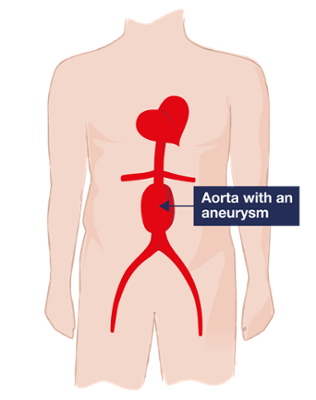
The aorta is the main blood vessel that supplies blood to the body.
Sometimes the wall of the aorta in the abdomen (tummy) can become weak and stretch to form an aneurysm. When this happens there is a risk that the aorta may split or tear (rupture).
A ruptured AAA can lead to serious blood loss that will need immediate emergency treatment.
Not every AAA will rupture, but if it does the chances of getting to hospital and surviving surgery are very poor.
Why is taking part in AAA screening important?
There are usually no signs or symptoms if you have an AAA. This means that you may not feel any pain or notice anything different.
The easiest way to find out if you have an AAA is by having a one-off ultrasound scan of your abdomen.
If an AAA is found you will be offered monitoring or treatment.
An AAA can happen to anyone but it is most common in men aged 65 and over. You are more at risk if you:
- Are a smoker.
- Have high blood pressure.
- Have high cholesterol.
- Have a family history of AAA.
How accurate is AAA screening?
Having an ultrasound scan is the best way of finding an AAA.
AAA screening is not 100% accurate.
Sometimes the abdominal aorta is difficult to see. This does not mean you have an aneurysm but you may need further ultrasound scans.
Reports
Abdominal aortic aneurysm screening programme reports
Data
Abdominal aortic aneurysm screening uptake/coverage data
-
AAA uptake/coverage by local authority and health board report 2021 to 2022
For uptake calculations, eligible men were those resident in Wales aged 65 years that were…
-
AAA uptake/coverage by local authority and health board report 2020 to 2021
For uptake calculations, eligible men were those resident in Wales aged 65 years that were…
-
AAA uptake/coverage by local authority and health board report 2019 to 2020
For uptake calculations, eligible men were those resident in Wales aged 65 years that were…
-
AAA uptake/coverage by local authority and health board report 2018 to 2019
For uptake calculations, eligible men were those resident in Wales aged 65 years that were…