

Principles for using behavioural science in practice
Most decisions in policy, service or communications development are made by people who are not behavioural science experts, and they do not need to be. However, behavioural science can add value to the efforts of nearly all practitioners and policy makers – supporting that development is a major goal for the Unit. Developing an understanding of the basic principles of behavioural science and how to enable its application within a project, team, or organisation are key to increasing its use across the system.
A first step in developing behaviour change interventions is to understand who needs to do what, when and for how long in order to achieve one’s objectives: i.e., to decide on the target behaviour(s) and target group(s).
Then we need to understand how to ensure that a) each target group has the necessary abilities to perform the behaviour(s), that b) their physical and social environment supports the behaviour, and that c) they are more motivated to enact the desired behaviour than anything else. The process of developing this understanding is called behavioural diagnosis and it can be achieved using the Capability-Opportunity-Motivation-Behaviour (COM-B) Model. To achieve this, we draw (as far as time and resources permit) on literature reviews, primary research, evaluations of previous interventions, and stakeholder engagement.
Next, we must decide what the best approach to achieving this is, selecting one or more approaches from a menu of evidence-based options (intervention types): education, persuasion, incentivisation, coercion, training, restriction, environmental restructuring, modelling or enablement. Each of these has strengths and limitations and is more appropriate in some situations than others.
We can then decide on how to implement these with a blend of policy options: providing a service or developing a product, mounting a communications or marketing campaign, legislating, producing regulations short of legislation, developing guidelines, using fiscal measures, and/or using environmental or social planning mechanisms. As with the intervention types, each implementation option will be more appropriate in some cases than others and usually more than one of them is needed.
Principles to apply during the development process
Applying the following principles will increase the chances of developing interventions that meet your objectives:
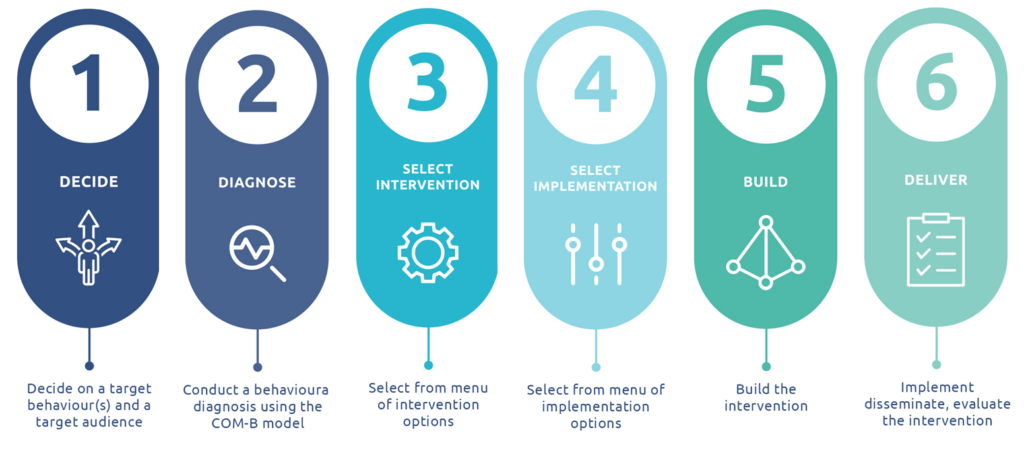
Learn more details about the development process steps guide.
Back to the behavioural science topic page