

Premature mortality accounts for twice as many years of life lost in the most deprived areas in 2016 to 2018
Authors: Analysis Team
Published on: 25th May 2022
Next update: To be announced
Contact for queries or feedback
This publication looks at premature mortality, years of life lost and how they link to deprivation.
Table of contents:
Introduction
Figure 1: General statistics for premature mortality, Wales, 2016-18

There are over 11,000 premature deaths per year in Wales. This equates to almost 150,000 years of life lost annually to premature mortality, of which 54,000 are excess years of life lost. The number of years of life lost in the most deprived fifth of areas is over twice that of the least deprived fifth of areas.
Years of life lost (YLL) calculates the number of years lost when a person dies prematurely (under 75 years of age) from any cause. With YLL both the number of deaths and the age of the person at death are taken into account thereby giving a greater weight to a death at age 5 compared to a death aged 70. Consequently YLL is a mortality measure which takes into account premature deaths which can inform public health priorities to help target interventions to prevent such deaths.
Figure 2: Premature mortality, count and rate per 100,000, WIMD 2019, all persons aged under 75, Wales, 2016-2018
Produced by Public Health Wales Observatory from PHM & MYE (ONS) & WIMD 2019 (WG)
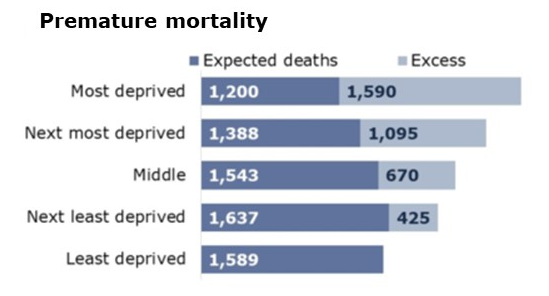
Figure 3: Premature years of life lost (YLL), count and crude rate per 100,000*, WIMD 2019, all persons aged under 75, Wales, 2016-2018
Produced by Public Health Wales Observatory from PHM & MYE (ONS) & WIMD 2019 (WG)
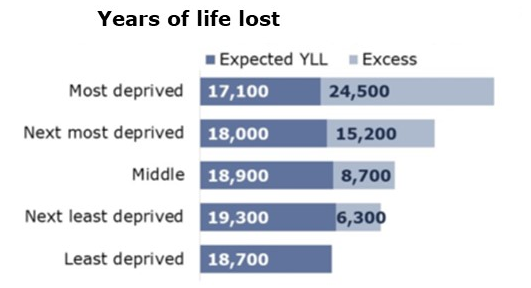
The above charts illustrate the full extent of premature mortality and YLL in each deprivation fifth in 2016-2018. They are split by colour to show the portion we would expect to see in each fifth if the mortality rates were the same as in the least deprived fifth and the amount which exceeds that. With each increase in level of deprivation, both the premature deaths and the YLL also increase. In addition, when the mortality rates of the least deprived are applied across all deprivation fifths, excess also rise in line with deprivation. Therefore, both premature mortality and YLL are around double that of the least deprived fifth in the most deprived fifth.
The large differences in both premature mortality rates and YLL between the most and least deprived areas are likely influenced by the social determinants of health (SDOH). The SDOH are complex and lead to inequalities in health across populations. They include general socio-economic, cultural and environmental factors; as well as social and community networks. Whilst many factors contribute to health, most lie outside of the control of health care systems such as employment and education opportunities and quality of housing. Many of these influences are also outside the control of an individual, although still contribute to an individual’s health and affect the ability to live a healthy life.
It is known that the prevalence of behavioural risk factors, e.g. smoking and poor nutrition, is higher among those living in the most deprived areas and this contributes towards worsening health outcomes. In addition, those in the most deprived areas face more barriers in accessing healthcare; issues such as less availability of transport or having poor health literacy leading to uncertainty of when to seek medical advice. This leads to those in deprived areas having a greater chance of being diagnosed later when a treatable disease may have progressed further and losing their life prematurely (NHS England, 2018).
Childhood mortality makes a larger contribution to YLL due to the greater number of years they could have lived. As children aged under 5 years living in deprived areas are over twice as likely to die prematurely as a child of the same age from the least deprived areas there will be a greater contribution to YLL in deprived areas (National Child Mortality Database (England), 2021).
There are large and persistent health inequalities in Wales which lead to worse health outcomes and lower life expectancy in the most deprived areas. Public Health Wales are committed to reducing health inequalities with the long term strategy focusing on how we can have maximum impact in improving health and well-being and reducing health inequalities in Wales. You can find further information regarding the Public Health Wales priorities.
Useful Links
- “Improving access for all: reducing inequalities in access to general practice services”, NHS England, 2018. Available at: https://www.england.nhs.uk/wp-content/uploads/2017/07/inequalities-resource-sep-2018.pdf
- “Child Mortality and Social Deprivation”, National Child Mortality Database (England), 2021 Available at: https://ncmd.info/wp-content/uploads/2021/05/NCMD-Child-Mortality-and-Social-Deprivation-report_20210513.pdf