

Your antenatal blood test result: you are a haemoglobin E carrier
How your test result is written
Your result is written as ‘results consistent with haemoglobin E carrier’ (HbA/E). The letter A represents your usual haemoglobin A gene. The letter E represents your haemoglobin E gene.
What your blood test result means
Haemoglobin is the substance in red blood cells that carries oxygen around your body. Being a haemoglobin E carrier means you have inherited one usual haemoglobin gene called haemoglobin A from one biological parent and one haemoglobin E gene from your other biological parent. Because you have inherited haemoglobin A from one parent, you are healthy. Being a carrier does not make you ill.
Knowing that you are a haemoglobin E carrier means that you could pass the haemoglobin E gene on to your baby. If your baby’s biological father is also a carrier, this means together you could have a baby with an inherited haemoglobin condition.
Please let your healthcare professional know if you:
- became pregnant following fertility treatment with donor sperm or a donor egg;
- have had a bone marrow or stem cell transplant; or
- are pregnant as a surrogate.
Inherited haemoglobin conditions
Haemoglobin conditions are blood disorders inherited from both biological parents. There are many haemoglobin conditions. The type of condition your baby could inherit will depend on the haemoglobin genes both biological parents have. Some conditions are more serious than others. The most serious conditions are called sickle cell disorders or transfusion dependent thalassaemia (thalassaemia major). There are different types of sickle cell disorders.
Your healthcare professional can discuss this with you, so that you understand what condition your baby could inherit and how this could affect the health of your baby.
How would my baby inherit a sickle cell disorder?
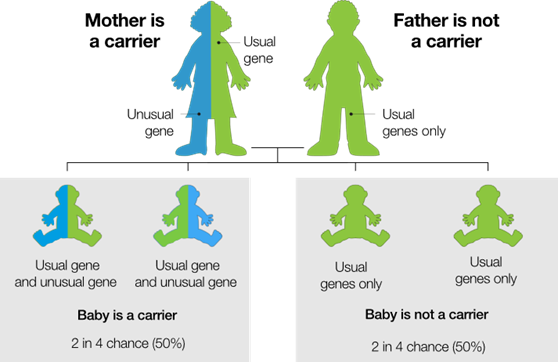
One biological parent is a carrier and the other biological parent is not
If your baby’s biological father has two usual haemoglobin genes (AA), there is a 2 in 4 (50%) chance your baby will be a haemoglobin E carrier (like you) and a 2 in 4 (50%) chance they will have two usual haemoglobin genes (AA).
See diagram below. These chances are the same in every pregnancy for this couple.
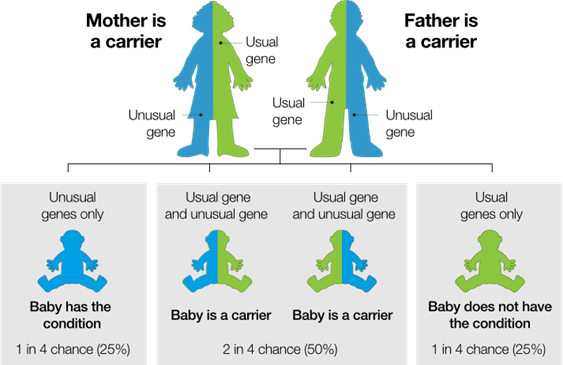
What if both biological parents are carriers?
If your baby’s biological father is also a carrier, there is a 1 in 4 (25%) chance your baby will inherit a haemoglobin condition. The seriousness of the condition will depend on what haemoglobin genes are inherited.
There is also a 2 in 4 (50%) chance your baby will be a carrier (like you), and a 1 in 4 (25%) chance your baby will have usual haemoglobin genes (AA). See diagram below.
See diagram below. These chances are the same in every pregnancy for this couple.
Should my baby’s biological father be offered testing?
If your baby’s biological father has an unusual haemoglobin gene it is important to identify the type of gene and the chance of your baby inheriting a haemoglobin condition. For this reason, we will also invite the baby’s biological father for screening. He will only know if he carries a gene for unusual haemoglobin if he has a blood test to check his haemoglobin type.
Information for fathers invited for a screening test for sickle cell disorder and thalassaemia major
If the test shows your baby’s biological father is a carrier of an unusual haemoglobin gene you will be offered specialist counselling and prenatal diagnosis.
What happens when my baby is born?
All babies are offered a newborn bloodspot screening test around four days after their birth. This test will screen for sickle cell disorder.
Should I tell my family the result?
Other family members, such as brothers and sisters, aunts, uncles and cousins, may want to consider getting tested as they could be carriers too. Sharing this information with them may be helpful.
Next steps and choices
You can also:
- let your GP or healthcare professional know you are a haemoglobin E carrier; and
- contact All Wales Medical Genomics Service (AWMGS) where you can get free information and advice to help you understand the implications of being a haemoglobin E carrier.
More information
You can get more information from the following.
https://111.wales.nhs.uk/encyclopaedia/t/article/thalassaemia/