

About newborn hearing screening - The audiology clinic – testing
This page gives more information for parents whose baby has been referred for a hearing assessment from the newborn hearing screening test.
What does it mean if my baby has been referred for a hearing assessment?
Your baby has been referred to your local audiology department for a hearing assessment with an audiologist (hearing specialist). This is because the hearing screening test did not show a clear response from one or both of your baby’s ears. This does not necessarily mean your baby has a hearing loss.
It may be because:
- Your baby was unsettled;
- There was fluid in the ear (from the birth);
- There was too much noise near your baby when the test was done; or
- Your baby has a hearing loss.
It is highly recommended that your baby has a further hearing test. You can choose whether or not your baby has this test.
For every 10 babies who have this hearing test, one will have a permanent hearing loss.

When will the assessment be done?
You will be sent an appointment within 4 week’s of your baby’s last hearing screening test. If your baby spent time in the special care baby unit (SCBU) this appointment will be sent within 8 week’s.
Babies who were born early will be tested after the date they were due to be born. This allows time for your baby’s hearing to develop.
Where will the assessment be done?
You will be offered an appointment at your local Audiology Clinic. The Audiology team will contact you to arrange the appointment.
How long will the assessment take?
The assessment usually takes about 2 hours, which includes the time needed to settle your baby. If your baby is unsettled it may take a little longer. Sometimes a few different tests need to be done and you need enough time to talk to the audiologist about the results. Some babies will need to come back on another day for more tests.
What do I need to bring with me?
It is helpful to bring your baby’s seat, buggy or pram and feeds and nappies as required. Because the tests need to be done in quiet conditions, it is better if other children can be looked after by someone else. Remember to leave enough time to park your car.
Does my baby need to be asleep?
Your baby will need to be settled or asleep for the hearing test. Baby noise and movement can stop the audiologist from seeing a response from your baby’s ears, so the assessment is done when babies are still sleeping a lot in the day. The audiologist will give you time to settle your baby at the appointment.
How will my baby’s hearing be tested?
There are a few different tests that may be done. The audiologist will explain each test to you.
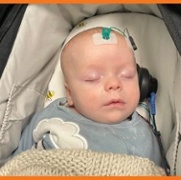
Small sticky pads are put on your baby’s head and behind the ears. Earphones are put into or over your baby’s ears, which will make different sounds. The equipment shows the audiologist how your baby’s ears are responding to the sound.
Results
Clear response:
If both of your baby’s ears show a clear response, this means that your baby is unlikely to have a hearing loss. The audiologist will give you information on how babies respond to sound as they grow. They will tell you what to do if you are worried about your baby’s hearing.
The test may not show a clear response:
If one or both of your baby’s ears does not show a clear response, the audiologist will explain what this means.
There are different types and levels of hearing loss. More tests may be needed before you know about your baby’s hearing. These tests may be done during your first appointment or further appointments may be needed. The audiologist will plan with you the best time for your baby to have more tests.
Further tests
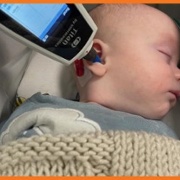
There are other tests that the audiologist may do to find out more information about your baby’s ears and hearing. One of these checks to see if there is fluid in the ear. For this test, a small soft-tipped earpiece is put in the outer part of your baby’s ear and a result is recorded on a machine.
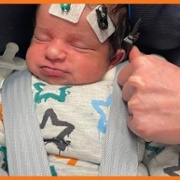
The other test checks how your baby’s inner ears are responding to sound. To do this test, a small sound maker would be placed behind your baby’s ear(s).
This can be a worrying time. The audiologist will answer any questions you have. If your baby has a hearing loss, you will be offered support and given more information.
Page last reviewed: 25th March 2026