

Cancer survival in Wales
Authors: Analysis Team, Welsh Cancer Intelligence and Surveillance Unit
Published on: 26th March 2026
Next update: 2027
Contact for queries or feedback
Introduction
This publication reports on survival of all cancers for registration years between 2002 and 2022. Where possible, one-year, five-year and ten-year net and observed survival are presented by one-year and five-year rolling periods for men, women and persons aged 15-99 for Wales, health boards and area deprivation fifths. Cancer survival by stage at diagnosis is presented for diagnoses between 2011 and 2022.
Main points
For people diagnosed with cancer in Wales during 2018 to 2022, 75% survived one year from diagnosis and 60% survived five years from diagnosis, after accounting for other causes of death.
Cancer survival improved steadily from the early 2000s to the mid 2010s. Between the 2002-2006 and 2014-2018 diagnosis periods, one year survival rose by 8 percentage points and five year survival by 9 percentage points (Figure 1).
Figure 1: Trends in one- and five-year survival of cancer in Wales
One- and five-year age-standardised net survival (%), all cancers excluding NMSC, persons aged 15-99, Wales, 2002-2006 to 2018-2022
Produced by Public Health Wales, using cancer registration data (WCISU), public health mortality (PHM) and mid-year population estimates (MYE) (ONS) and Welsh Index of Multiple Deprivation (WIMD) (WG)
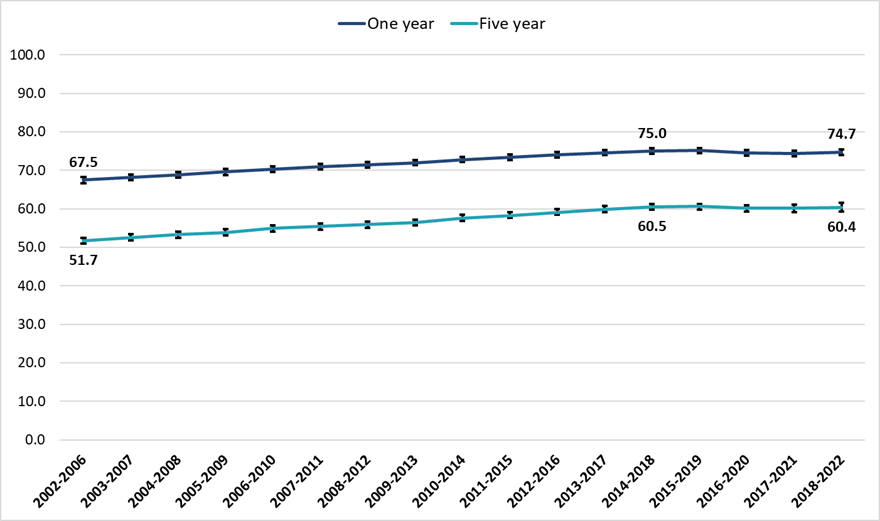
However, improvements have since stalled, with trends remaining broadly flat up to 2018-2022. This levelling off began before the pandemic, from the 2015-2019 period.
One-year cancer survival has recovered significantly following the COVID-19 pandemic.
Looking at single years of diagnosis, one-year cancer survival fell by 4 percentage points between 2019 and 2020, around the onset of the COVID-19 pandemic. By 2022, it had recovered to pre-pandemic levels (Figure 2).
Figure 2: Trends in one-year survival of cancer in Wales
One-year age-standardised net survival (%), all cancers excluding NMSC, persons aged 15-99, Wales, 2002-2022
Produced by Public Health Wales, using cancer registration data (WCISU), PHM and MYE (ONS) and WIMD (WG)
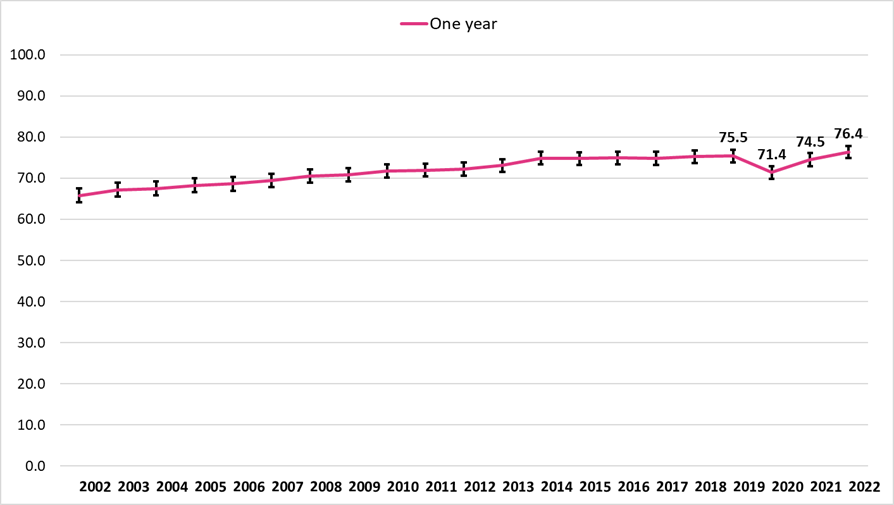
Cancers typically diagnosed at a later stage – such as colorectal and lung – experienced the largest temporary declines in one-year survival but have since recovered well. In contrast, cancers more often diagnosed earlier – including prostate and breast – were less affected.
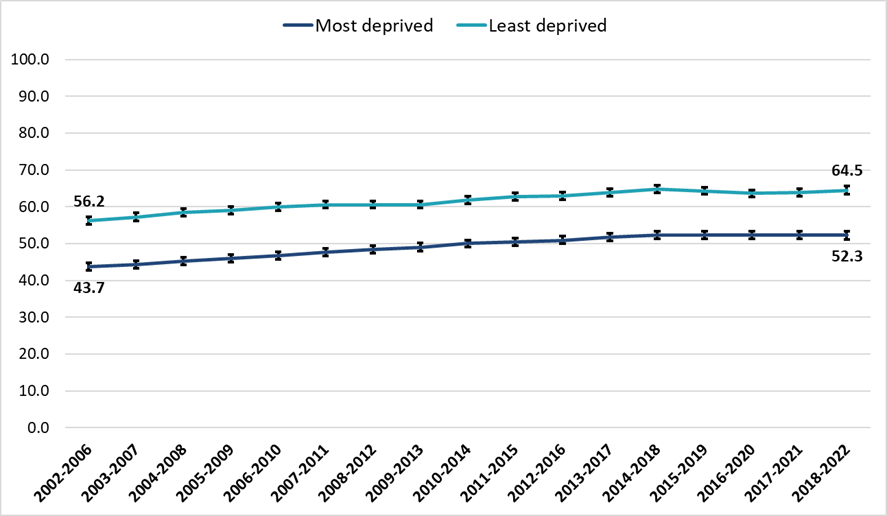
Cancer survival worsens with increasing area deprivation. In 2018-2022, five-year survival was significantly higher in the least deprived areas than in the most deprived areas.
Despite broad improvements in cancer survival, the area deprivation gap has remained stable, with estimates around 10-13 percentage points higher in the least deprived areas (Figure 3).
Figure 3: Trends in five-year survival of cancer in Wales by area deprivation fifth
Five-year unstandardised net-survival (%) by deprivation fifth, all caners excluding NMSC, persons aged 15-99, Wales, 2002-2006 to 2018-2022
Produced by Public Health Wales, using cancer registration data (WCISU), PHM and MYE (ONS) and WIMD (WG)
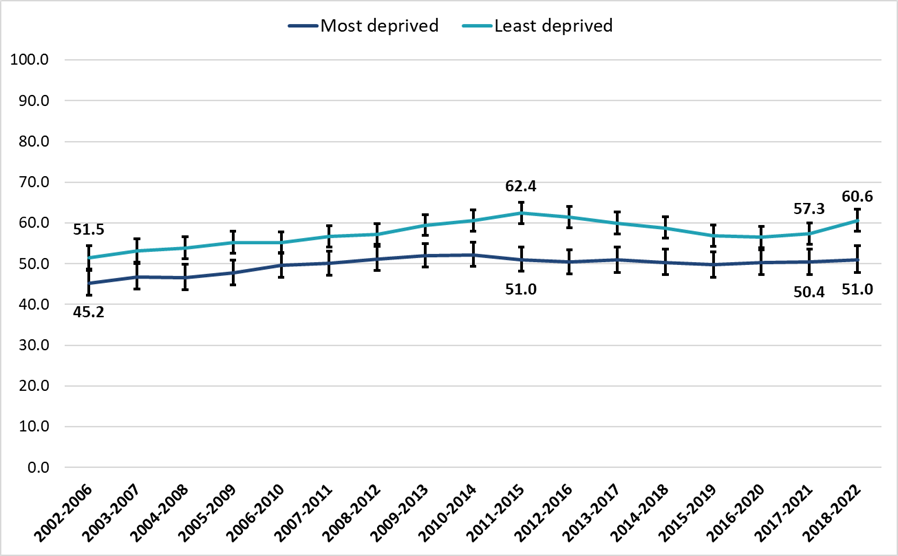
Colorectal cancer has consistently had the widest deprivation gap amongst the most common cancers. This difference narrowed up to the 2017–2021 diagnosis period but has since widened again, driven by improving five-year survival in the least deprived areas alongside little change in the most deprived (Figure 4).
Figure 4: Trends in five-year survival of colorectal (bowel) cancer in Wales by area deprivation fifth
Five-year unstandardised net survival (%) by deprivation fifth, colorectal cancer, persons aged 15-99, Wales, 2002-2006 to 2018-2022
Produced by Public Health Wales, using cancer registration data (WCISU), PHM and MYE (ONS) and WIMD (WG)
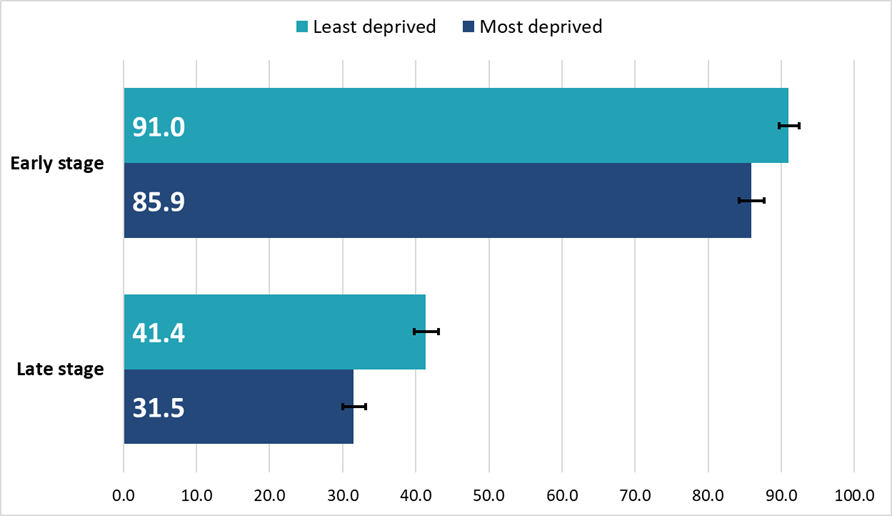
The area deprivation gap in five-year unstandardised net survival is almost twice as large for late-stage diagnosis than for early-stage.
For all stageable cancers, deprivation inequalities are significant for both stage groupings, though markedly wider for late-stage diagnosis (Figure 5).
Figure 5: Five-year survival of early- and late-stage diagnoses of stageable cancers in Wales by area deprivation fifth during the diagnosis period 2018-2022
Five-year unstandardised net survival (%) by stage at diagnosis and deprivation fifth, all stageable cancers, persons aged 15-99, Wales, 2018-2022
Produced by Public Health Wales, using cancer registration data (WCISU), PHM and MYE (ONS) and WIMD (WG)
Site-specific relationships are less consistent. For colorectal five-year survival and lung cancer one-year survival, deprivation gaps are significant for late-stage, but not early-stage diagnosis. In contrast, prostate and female breast cancers show smaller differences overall, with no clear or consistent relationship with deprivation across stage groupings.
Interpretation should consider that COVID-19 disrupted access to screening, GP referral and diagnostics, and this may have affected stage at diagnosis differently across deprivation groups.
Data tables
Access the data related to this report
Technical information
Pre-release list
Dr Tracey Cooper, NHS Wales Cancer Board Chair and Chief Executive of Public Health Wales
Professor Tom Crosby, National Cancer Clinical Director for Wales
Anthony Davies, Senior Policy Manager, Value Based Healthcare Policy Team, Welsh Government
Public Health Scotland: Thomas Godfrey, Greig Stanners, Callum Rintoul, Gemma Turner
Related reports
-
Macmillan-WCISU partnership including cancer incidence, prevalence and comorbidities
Contact for queries or feedback Introduction Macmillan Cancer Support and the Welsh Cancer Intelligence and Surveillance Unit of Public Health Wales entered into a partnership in April 2017. The aim is to deliver […]
Published on: 27th March 2019
-
Non-melanoma skin cancer incidence in Wales
Next update: To be announced Contact for queries or feedback Introduction This is the most recent Official Statistics publication for non-melanoma skin cancer (NMSC) incidence in Wales. Statistics are available by cancer […]
Published on: 30th May 2024
-
Pathology samples indicating new cases of cancer in Wales
Next update: 18th June 2026 Contact for queries or feedback Introduction This experimental analysis examines the monthly count of individual patients with a pathology sample indicating a primary malignant tumour […]
Published on: 26th March 2026
-
Cancer mortality in Wales
Next update: 15 July 2026 Contact for queries or feedback Introduction This publication reports on deaths registered between 2002 and 2024 with outputs presented by single and three-year rolling periods […]
Published on: 18th June 2025
-
Public Health Outcomes Framework Reporting Tool
Next update: 17th June 2026 Contact for queries or feedback Introduction Main points In this iteration, the following indicators have been updated: The key messages for these indicators are as […]
Published on: 18th March 2026
-
Cancer incidence in Wales
Next update: To be announced (2026) Contact for queries or feedback Introduction This publication reports on cancers registered between 2002 and 2022 with outputs presented by single and three-year rolling periods […]
Published on: 23rd October 2025
Related data
-
Cancer incidence and prevalence for Cluster Networks in Wales data
Last reviewed: 12th July 2018
-
Non-melanoma skin cancer incidence in Wales data
Last reviewed: 30th May 2024
-
Public Health Outcomes Framework Reporting Tool Data
Last reviewed: 18th March 2026
-
Pathology samples indicating new cases of cancer in Wales data
Last reviewed: 26th March 2026
-
Cancer mortality in Wales data
Last reviewed: 18th June 2025