

Cancer incidence in Wales
Authors: Analysis Team, Welsh Cancer Intelligence and Surveillance Unit
Published on: 23rd October 2025
Next update: To be announced (2026)
Contact for queries or feedback
Introduction
This publication reports on cancers registered between 2002 and 2022 with outputs presented by single and three-year rolling periods for men, women and persons for Wales, health boards, local authorities and area deprivation fifths. Cancer incidence by stage at diagnosis is presented for diagnoses between 2011 and 2022 by single and three-year rolling periods for men, woman and persons for Wales and area deprivation fifths.
Main points
For the first time, we are reporting on stage at cancer diagnosis by area deprivation. We are also reporting on neuroendocrine cancers (NENs) and small cell lung cancers (SCLC).
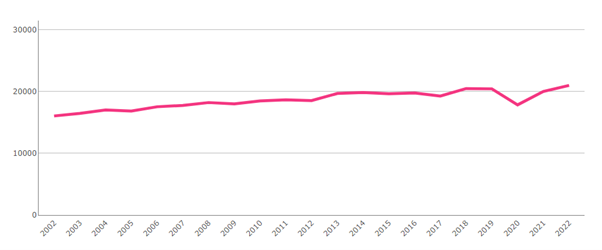
New cases of cancer increased by 18% in 2022 (21,006 cases) compared to the pandemic’s first year (17,858 cases in 2020). By 2022, the number of new cases was higher than before the pandemic (annual average 20,472 cases for 2018-2019). This could suggest the beginning of a return to pre-pandemic trends (Figure 1), along with a rebound of some of the delayed cases that were not detected during the pandemic.
The number of new cases of cancer increased by almost a third (31%) in just over two decades (from 2002 to 2022). This was an average annual increase of 1.5% (Figure 1).
Figure 1: Trends in the annual number of new cases of cancer
All cancers excluding NMSC, count, persons, all ages, Wales, 2002-2022
Produced by Public Health Wales, using cancer registration data (WCISU)
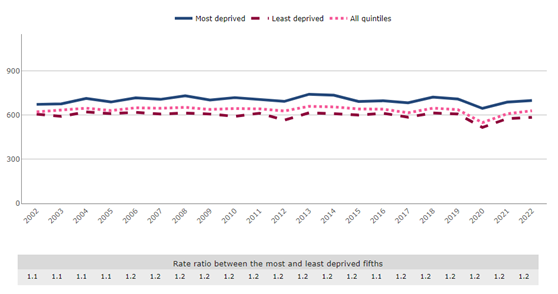
The incidence rate was 20% higher in the most deprived areas compared to the least deprived areas in 2022 (Figure 2). This 20% gap has remained since 2006.
Figure 2: Trends in cancer incidence rates by area deprivation fifth
All cancers excluding NMSC, European age-standardised rate, persons, all ages, Wales, 2002-2022
Produced by Public Health Wales, using cancer registration data (WCISU), mid-year estimates (MYE) (ONS) and Welsh Index of Multiple Deprivation (WIMD) (WG)
Over half of all cancer cases in 2022 were in people aged 70 and over. This pattern has remained throughout the years we report on (2002-2022). The aging profile of the Welsh population explains our findings; getting older is the main risk factor for developing most cancers.
The lasting effects of the pandemic may continue to influence incidence trends in the coming years. We will continue to monitor and report on these developments as they evolve.
Stage at diagnosis by area deprivation
As deprivation increased from the least to the most deprived fifth (20%) of areas in Wales, the proportion of later-stage diagnoses also increased, with a higher proportion of late-stage diagnoses compared to early-stage in the most deprived areas between 2011 and 2022 (Figure 3).
Figure 3: Trends in the proportion of early and late-stage diagnoses by area deprivation fifth
All stageable cancers, proportion (%), persons, all ages, Wales, 2011-2022
Produced by Public Health Wales, using cancer registration data (WCISU), MYE (ONS) and WIMD (WG)
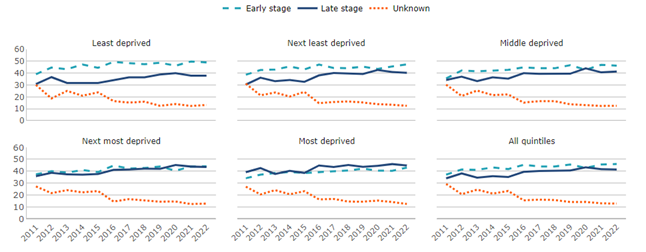
The incidence rate of early-stage cancer diagnoses decreased during the pandemic in 2020 across all area deprivation fifths, whilst the rate of late-stage diagnoses remained slightly more stable. This appears to start recovering in the years following (2021-2022), with the rate of both early and late-stage diagnoses increasing across nearly all deprivation fifths, with a stronger recovery in early-stage rates.
Lung and colorectal (bowel) cancer
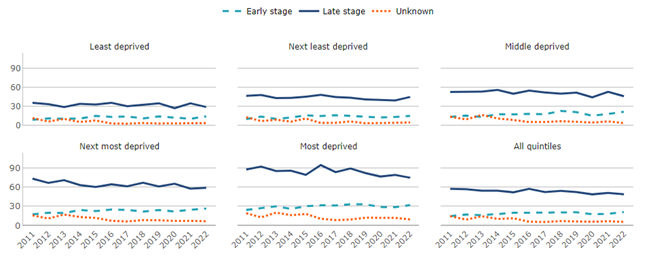
The overall incidence rate for lung cancer was 2.3 times higher in the most deprived fifth of areas, compared to the least deprived in 2022. The rate of late-stage lung cancer diagnoses is considerably higher than early-stage across all areas of deprivation (Figure 4).
In the most deprived areas, the late-stage lung cancer incidence rate was 2.3 times higher than for early-stage in 2022. In comparison, in the least deprived areas, the late-stage incidence rate was 2 times higher than early-stage. When we compare the late-stage incidence rate in the most deprived areas to the late-stage rate in the least deprived areas in 2022, it is 2.6 times higher in the most deprived areas (Figure 4).
Figure 4: Trends in lung cancer incidence rates by stage at cancer diagnosis and area deprivation fifth
Lung cancer, European age-standardised rate, persons, all ages, Wales, 2011-2022
Produced by Public Health Wales, using cancer registration data (WCISU), MYE (ONS) and WIMD (WG)
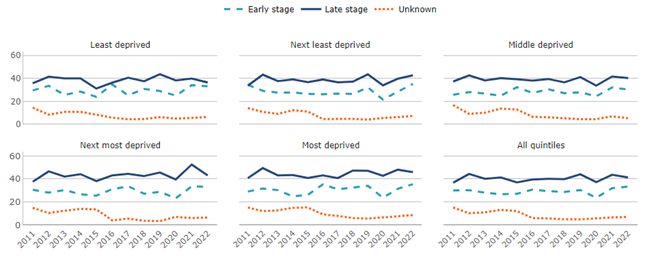
Similarly to lung cancer, colorectal cancer had a higher rate of late-stage diagnoses compared to early-stage across all area deprivation fifths in Wales throughout 2011-2022 (Figure 5). The gap in rates between early and late-stage diagnoses widened as the level of area deprivation increased in 2022.
Figure 5: Trends in colorectal cancer incidence rates by stage at cancer diagnosis and area deprivation fifths
Colorectal cancer, European age-standardised rate, persons, all ages, Wales, 2011-2022
Produced by Public Health Wales, using cancer registration data (WCISU), MYE (ONS) and WIMD (WG)
Female breast and prostate cancer
In contrast to the later-stage profile of lung and colorectal cancer diagnoses, female breast cancers and prostate cancers tend to be diagnosed at an earlier stage.
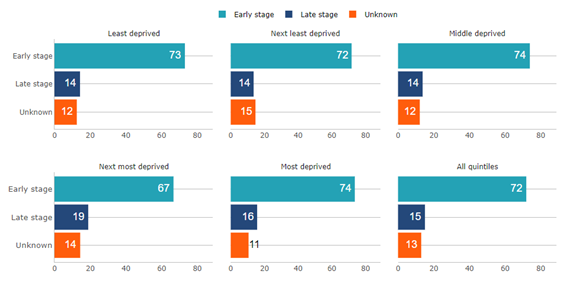
In 2022, 72% of women who were diagnosed with breast cancer were diagnosed at an early stage. This was similar across all deprivation fifths throughout the reporting period (2011-2022) (Figure 6).
Figure 6: The proportion of early and late-stage diagnoses of female breast cancer by area deprivation fifth in 2022
Breast cancer, proportion (%), women, all ages, Wales, 2022
Produced by Public Health Wales, using cancer registration data (WCISU), MYE (ONS), and WIMD (WG)
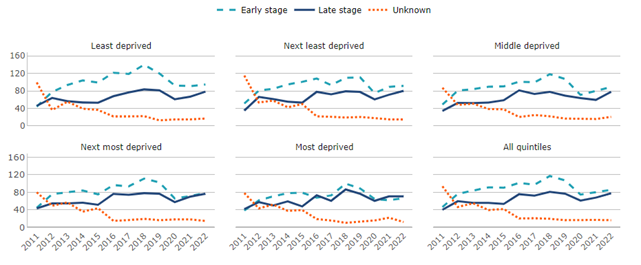
The number of prostate cancers diagnosed dropped by 23% during the pandemic before starting to increase from 2021 onwards across all stages and area deprivation fifths. However, the rate of men diagnosed at later stages overtook earlier-stage in the most deprived fifth in 2021 and 2022, whilst men in lesser deprived fifths had higher rates of early-stage diagnoses (Figure 7).
Figure 7: Trends in prostate cancer incidence rates by stage at cancer diagnosis and area deprivation fifths
Prostate cancer, European age-standardised rate, men, all ages, Wales, 2011-2022
Produced by Public Health Wales, using cancer registration data (WCISU), MYE (ONS) and WIMD (WG)
Neuro-endocrine cancers (NENs) and small cell lung cancer (SCLC)
In 2022, there were 359 cases of epithelial NENs (excluding SCLC) and 231 cases of small cell lung cancer in Wales. This equates to incidence rates of 11 cases and 7 cases per 100,000 persons, respectively.
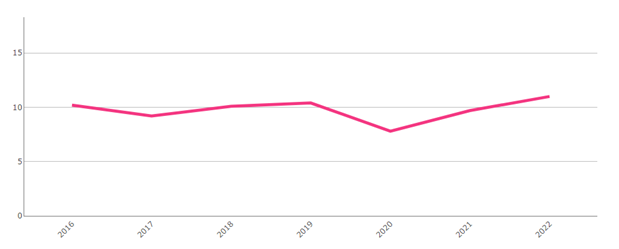
Between 2016 and 2022, small cell lung cancer made up on average 9.5% of all lung cancer cases in Wales annually.
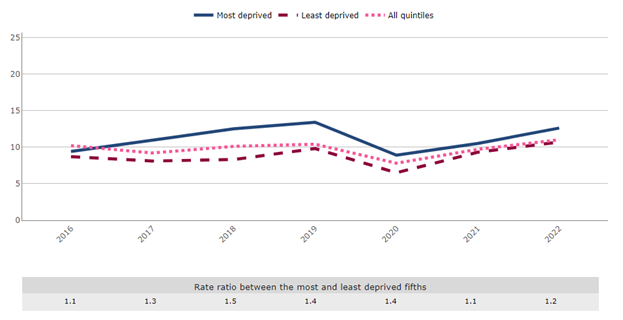
The rate of epithelial NENs followed a similar trend to other cancer types during the pandemic, with the rate dropping before starting to recover in the following years (Figure 8).
Figure 8: Trends in the epithelial neuro-endocrine cancer (excluding small cell lung cancer) incidence rate
Epithelial NEN excluding SCLC, European age-standardised rate, persons, all ages, Wales, 2016-2022
Produced by Public Health Wales, using cancer registration data (WCISU), MYE (ONS) and WIMD (WG)
Similar to some other cancer types, the incidence rate of epithelial NENs was higher in the most deprived fifth compared to the least deprived between 2016 and 2022 (Figure 9).
Figure 9: Trends in the epithelial neuro-endocrine (excluding small cell lung cancer) incidence rate by area deprivation fifth
Epithelial NEN excluding SCLC, European age-standardised rate, persons, all ages, Wales, 2016-2022
Produced by Public Health Wales, using cancer registration data (WCISU), MYE (ONS) and WIMD (WG)
Data tables
Access the data related to this report
Technical information
Pre-release list
Dr Tracey Cooper, NHS Wales Cancer Board Chair and Chief Executive of Public Health Wales
Professor Tom Crosby, National Cancer Clinical Director for Wales
Anthony Davies, Senior Policy Manager, Value Based Healthcare Policy Team, Welsh Government
Related reports
-
Macmillan-WCISU partnership including cancer incidence, prevalence and comorbidities
Contact for queries or feedback Introduction Macmillan Cancer Support and the Welsh Cancer Intelligence and Surveillance Unit of Public Health Wales entered into a partnership in April 2017. The aim is to deliver […]
Published on: 27th March 2019
-
Non-melanoma skin cancer incidence in Wales
Next update: To be announced Contact for queries or feedback Introduction This is the most recent Official Statistics publication for non-melanoma skin cancer (NMSC) incidence in Wales. Statistics are available by cancer […]
Published on: 30th May 2024
-
Pathology samples indicating new cases of cancer in Wales
Next update: 18th June 2026 Contact for queries or feedback Introduction This experimental analysis examines the monthly count of individual patients with a pathology sample indicating a primary malignant tumour […]
Published on: 26th March 2026
-
Cancer survival in Wales
Next update: 2027 Contact for queries or feedback Introduction This publication reports on survival of all cancers for registration years between 2002 and 2022. Where possible, one-year, five-year and ten-year […]
Published on: 26th March 2026
-
Cancer mortality in Wales
Next update: 15 July 2026 Contact for queries or feedback Introduction This publication reports on deaths registered between 2002 and 2024 with outputs presented by single and three-year rolling periods […]
Published on: 18th June 2025
-
Public Health Outcomes Framework Reporting Tool
Next update: 17th June 2026 Contact for queries or feedback Introduction Main points In this iteration, the following indicators have been updated: The key messages for these indicators are as […]
Published on: 18th March 2026
Related data
-
Cancer incidence and prevalence for Cluster Networks in Wales data
Last reviewed: 12th July 2018
-
Non-melanoma skin cancer incidence in Wales data
Last reviewed: 30th May 2024
-
Public Health Outcomes Framework Reporting Tool Data
Last reviewed: 18th March 2026
-
Pathology samples indicating new cases of cancer in Wales data
Last reviewed: 26th March 2026
-
Cancer mortality in Wales data
Last reviewed: 18th June 2025