

Cancer mortality in Wales
Authors: Analysis Team, Welsh Cancer Intelligence and Surveillance Unit
Published on: 18th June 2025
Next update: 15 July 2026
Contact for queries or feedback
Introduction
This publication reports on deaths registered between 2002 and 2024 with outputs presented by single and three-year rolling periods for men, women and persons for Wales, health boards, local authorities and area deprivation fifths.
Main points
Cancer remains the leading cause of mortality in Wales, accounting for a quarter of all deaths in 2024. There were 9,123 new cancer deaths in 2024.
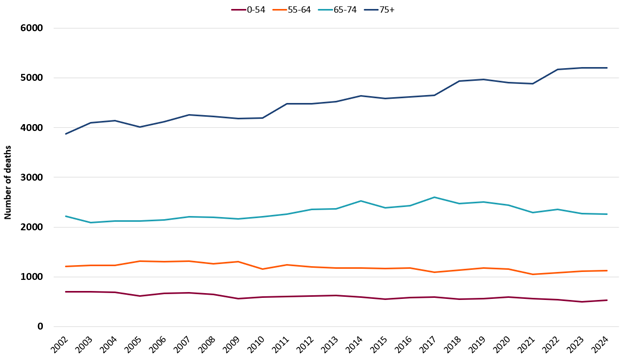
Lung, bowel (colorectal), prostate and female breast cancers accounted for 4 in 10 cancer deaths in Wales in 2024, with lung cancer alone accounting for 2 in 10 cancer deaths. Over half of all cancer deaths in Wales are in people aged 75 and over (Figure 1). This has been steadily rising from 48% in 2002 to 57% in 2024, as the population in Wales becomes more elderly.
Figure 1: Cancer mortality by age group, all cancers excluding NMSC, count, persons, Wales, 2002-2004
Produced by Public Health Wales, using Public Health Mortality (PHM) from the Office for National Statistics (ONS)
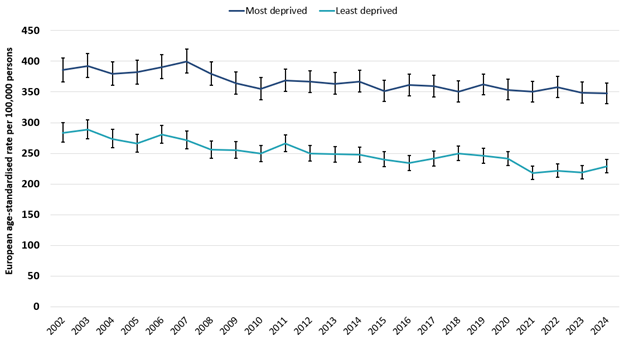
Cancer mortality rates remain higher in the most deprived areas compared to the least deprived areas in Wales (Figure 2), with no real improvements over the reported period. The rate was 52% higher in the most deprived areas in 2024.
Figure 2: Cancer mortality by deprivation fifth, all cancers excluding NMSC, European age-standardised rate, persons, all ages, Wales, 2002-2024
Produced by Public Health Wales, using PHM and Mid-Year Estimates (MYE) from ONS
The picture of cancer mortality post-pandemic is still unclear. The lasting effects of the pandemic – especially among those now presenting with more advanced disease – may continue to influence mortality trends in the coming years, which we will keep monitoring and reporting on.
Other key findings
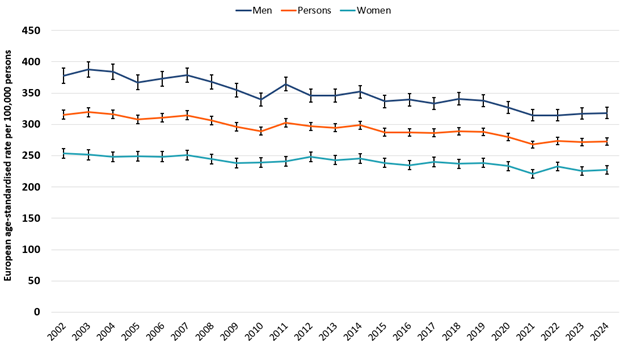
Pre-pandemic, the number of deaths from cancer in Wales gradually increased between 2002 and 2019. However, this is primarily driven by the ageing population with the mortality rate decreasing during this period (Figure 3).
Post-pandemic, the number of annual cancer deaths has plateaued, with the numbers now slightly less than the pre-pandemic level in 2019. The cancer mortality rate has also plateaued (Figure 3). This is true for both men and women.
Men continue to have more deaths from cancer than women in Wales (4,895 deaths vs. 4,228 deaths in 2024), although the gap in the mortality rate is narrowing (Figure 3).
Figure 3: Cancer mortality by sex, all cancers excluding NMSC, European age-standardised rate, all ages, Wales, 2002-2024
Produced by Public Health Wales, using PHM and MYE from ONS
Lung cancer is responsible for around a fifth of all cancer deaths in Wales, making it the leading cause of cancer mortality. Half of all lung cancer deaths occur in people aged 75 and over, highlighting the disease’s association with age and long-term exposure to risk factors such as smoking.
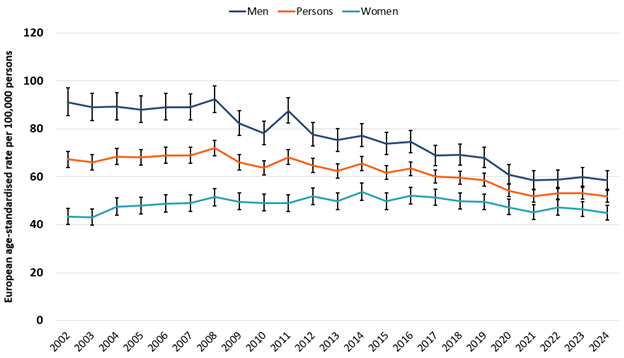
There has been a long-term decline in lung cancer mortality, driven largely by falling rates in men (Figure 4). Between 2002 and 2024, the mortality rate in men decreased by 38%. For women, mortality rates remained relatively static over the same period. This reflects a complex picture – while incidence in women increased between 2002 and 2016, survival also improved, offsetting the potential rise in deaths.
Figure 4: Cancer mortality by sex, lung cancer, European age-standardised rate, all ages, Wales, 2002-2024
Produced by Public Health Wales, using PHM and MYE from ONS
Lung cancer shows the widest socioeconomic inequalities in mortality of the four most common cancers (Figure 5). In 2024, mortality rates were 2.5 times higher in the most deprived areas compared to the least deprived. This mirrors smoking rates, which are 3 times higher in the most deprived areas than in the least deprived (National Survey for Wales).
Figure 5: Cancer mortality by deprivation fifth, lung cancer, European age-standardised rate, persons, all ages, Wales, 2002-2024
Produced by Public Health Wales, using PHM and MYE from ONS
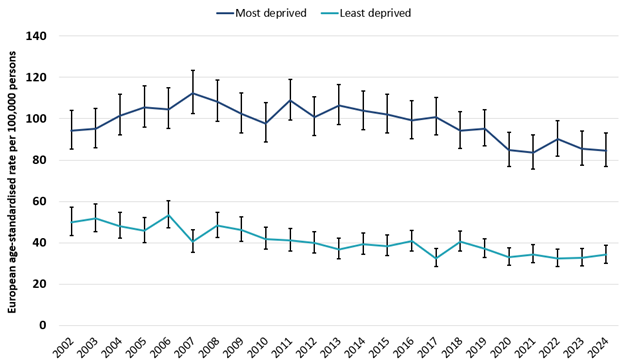
In 2024, bowel cancer had the second highest number of cancer deaths after lung cancer. However, it had the fourth highest mortality rate in Wales after lung, prostate and female breast cancers once adjusted for age. In 2024, 59% of bowel cancer deaths occurred in people aged 75 and over.
Female breast cancer also shows a plateauing of mortality rates in the post-pandemic years compared to a general decrease pre-pandemic, although fluctuations are seen year-on-year (Figure 6). A slight increase can be seen in 2024. However, it is too early to say whether this is the start of an increasing trend.
Figure 6: Cancer mortality, female breast cancer, European age-standardised rate, all ages, Wales, 2002-2024
Produced by Public Health Wales, using PHM and MYE from ONS
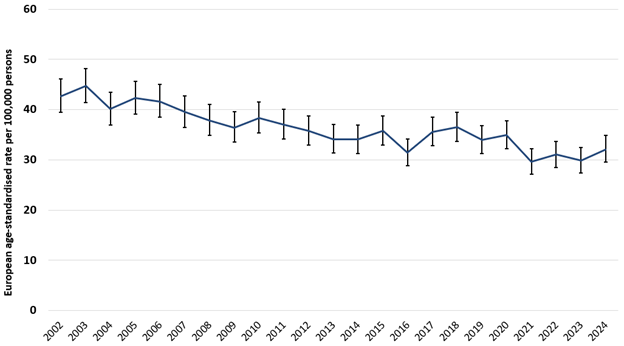
In 2024, prostate cancers accounted for 7% of all cancer deaths (13% of male cancers), making it the 3rd leading cause of cancer mortality overall and 2nd leading cause for men. Prostate cancer mortality has an older age profile, with 77% of deaths occurring in people aged 75 and over.
Data tables
Access the data related to this report
Technical information
Pre-release list
Dr Tracey Cooper, NHS Wales Cancer Board Chair and Chief Executive of Public Health Wales
Professor Tom Crosby, National Cancer Clinical Director for Wales
Anthony Davies, Senior Policy Manager, Value Based Healthcare Policy Team, Welsh Government
Related reports
-
Macmillan-WCISU partnership including cancer incidence, prevalence and comorbidities
Contact for queries or feedback Introduction Macmillan Cancer Support and the Welsh Cancer Intelligence and Surveillance Unit of Public Health Wales entered into a partnership in April 2017. The aim is to deliver […]
Published on: 27th March 2019
-
Non-melanoma skin cancer incidence in Wales
Next update: To be announced Contact for queries or feedback Introduction This is the most recent Official Statistics publication for non-melanoma skin cancer (NMSC) incidence in Wales. Statistics are available by cancer […]
Published on: 30th May 2024
-
Pathology samples indicating new cases of cancer in Wales
Next update: 18th June 2026 Contact for queries or feedback Introduction This experimental analysis examines the monthly count of individual patients with a pathology sample indicating a primary malignant tumour […]
Published on: 26th March 2026
-
Cancer survival in Wales
Next update: 2027 Contact for queries or feedback Introduction This publication reports on survival of all cancers for registration years between 2002 and 2022. Where possible, one-year, five-year and ten-year […]
Published on: 26th March 2026
-
Public Health Outcomes Framework Reporting Tool
Next update: 17th June 2026 Contact for queries or feedback Introduction Main points In this iteration, the following indicators have been updated: The key messages for these indicators are as […]
Published on: 18th March 2026
-
Cancer incidence in Wales
Next update: To be announced (2026) Contact for queries or feedback Introduction This publication reports on cancers registered between 2002 and 2022 with outputs presented by single and three-year rolling periods […]
Published on: 23rd October 2025
Related data
-
Cancer incidence and prevalence for Cluster Networks in Wales data
Last reviewed: 12th July 2018
-
Non-melanoma skin cancer incidence in Wales data
Last reviewed: 30th May 2024
-
Public Health Outcomes Framework Reporting Tool Data
Last reviewed: 18th March 2026
-
Pathology samples indicating new cases of cancer in Wales data
Last reviewed: 26th March 2026
-
Cancer mortality in Wales data
Last reviewed: 18th June 2025