

Non-melanoma skin cancer incidence in Wales
Authors: Analysis Team, Welsh Cancer Intelligence and Surveillance Unit
Published on: 30th May 2024
Next update: To be announced
Contact for queries or feedback
Introduction
This is the most recent Official Statistics publication for non-melanoma skin cancer (NMSC) incidence in Wales. Statistics are available by cancer type, geography, area deprivation status, sex, five-year age band, and tumour location. Measures include counts, crude rates and age-standardised rates. Data is currently available for the registration years 2016 to 2020.
Main points
Non-melanoma skin cancer (NMSC) includes two main cancer types: basal cell carcinoma (BCC) and cutaneous squamous cell carcinoma (cSCC), as well as other rare forms.
This publication uses the first per person per annum (PPPA) method of counting cases of BCC and cSCC, which means the first occurrence of these cancers for each person each year is recorded.
Wales Overview
In Wales, non-melanoma skin cancer (NMSC) was by far the most common cancer each year from 2016 to 2020. After adjusting for differences in age, the incidence rate was 2.5 times higher than prostate cancer in 2019 (pre-pandemic), which had the next highest rate. This remained consistent in 2020, with the NMSC incidence rate still 2.5 times higher than prostate cancer.
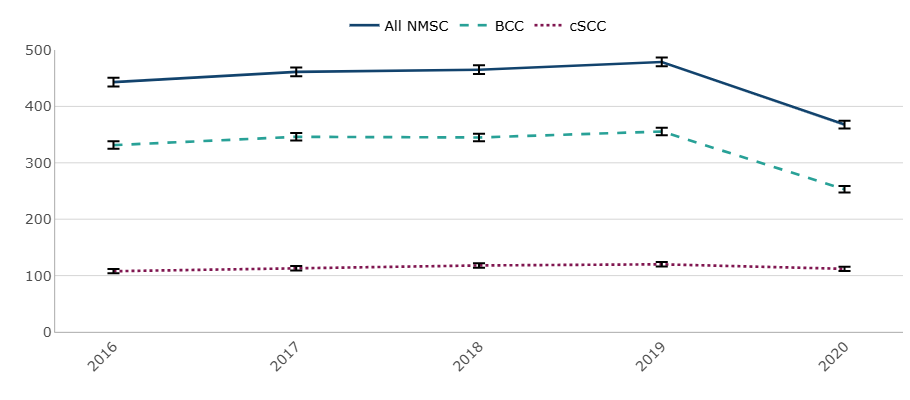
Age-standardised incidence rates of NMSC continue to increase worldwide. This trend is mirrored across Wales, where incidence of NMSC has increased year on year from 2016 to 2019. After adjusting for differences in age, the rate increased by 8% in Wales during this period, with 13,387 cases in 2016 compared to 15,112 in 2019. Global rates are predicted to continue rising until at least 2040 (Hu et al., 2022).
Diagnosed NMSC cases decreased by 22% in 2020, from 15,112 cases in 2019 to 11,792 in 2020. Due to the reduction in diagnosis of NMSC cases during the pandemic, after adjusting for differences in age, the rate decreased by 17% between 2016 and 2020. This reduction is most likely attributed to the re-direction of services towards the Covid-19 pandemic and changes in patient access to GP and hospital services.
NMSC made up 40% of all cases of cancer in Wales during 2020 and 94% of all skin cancers. There were 11,792 first occurrences of NMSC, compared to 17,461 cases of all other cancers combined. Non-melanoma and melanoma skin cancer together accounted for 43% of all cancers in Wales in 2020.
Risk factors
The main potentially preventable risk factor for NMSC is exposure to ultraviolet (UV) light, mainly from sunlight. This includes episodes of sunburn and long-term UV exposure. This risk factor is influenced by occupation (e.g. outdoor work); skin type; sunbed use; travel and holidays to sunnier locations (which is influenced by affluence); climate-driven weather patterns, and behaviour in sunshine such as seeking shade, clothing and hat-wearing, and sun-lotion use.
Whilst the risk factors for NMSC are well known, their interaction and how historical trends of these risk factors have affected current NMSC incidence rates remains unclear. The main cause of a steadily increasing NMSC incidence rate is therefore difficult to establish.
Cancer type
The most common form of NMSC in Wales is basal cell carcinoma (BCC) with 8,183 first occurrences in 2020. Cutaneous squamous cell carcinoma (cSCC) constitutes a smaller proportion with 3,528 first occurrences in 2020.
Both types of NMSC tend to be slow-growing and most people treated for NMSCs are cured. However, if left untreated they do have the potential to spread to other parts of the body. UV radiation from sun exposure is a major risk factor for both types. The risk of BCC is more highly associated with intermittent UV exposure such as sunburn, whilst cSCC is more associated with long-term sun exposure (Cancer Research UK, 2018).
NMSC is much more common in men than in women. After adjusting for differences in age, the incidence rate was nearly 97% higher (almost double) in men compared to women in 2020. There were 7,334 cases in men in 2020 and 4,458 cases in women.
NMSC incidence, European age-standardised rate per 100,000, persons, all ages, Wales by cancer type and sex, 2020
Produced by Public Health Wales, using incidence and pathology data (WCISU) and MYE (ONS)
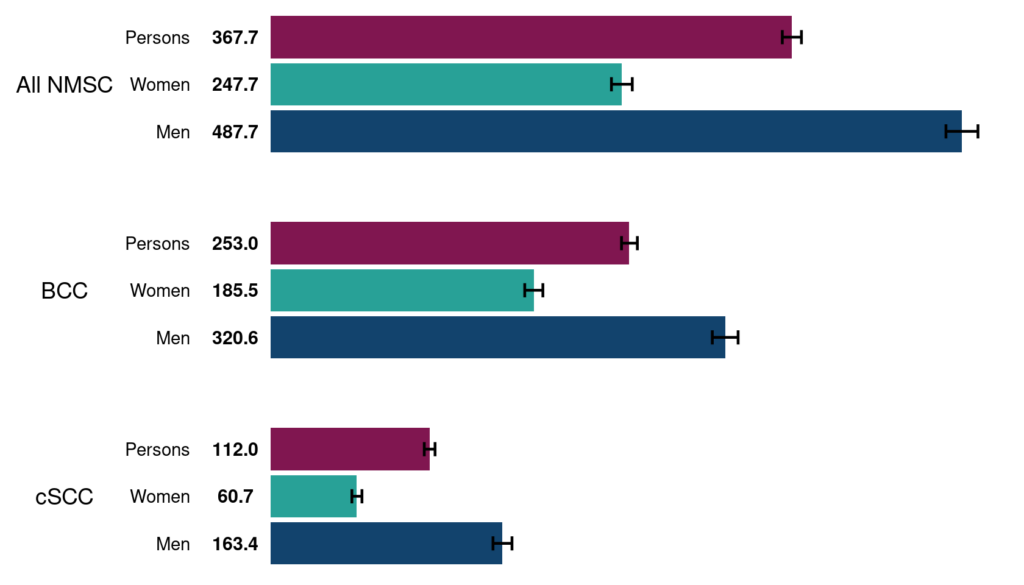
Our data demonstrates that the incidence of NMSC is increasing. However, cases decreased in 2020 due to the effect of the Covid-19 pandemic on NHS services and people’s healthcare-seeking behaviour. This is in keeping with longer-term trends in the incidence of melanoma skin cancer, which has similar risk factors. Information about the incidence of melanoma skin cancer can be found in our cancer incidence in Wales report.
NMSC incidence, European age-standardised rate per 100,000, persons, all ages, Wales by cancer type, 2016-2020
Produced by Public Health Wales, using incidence and pathology data (WCISU) and MYE (ONS)
Area deprivation
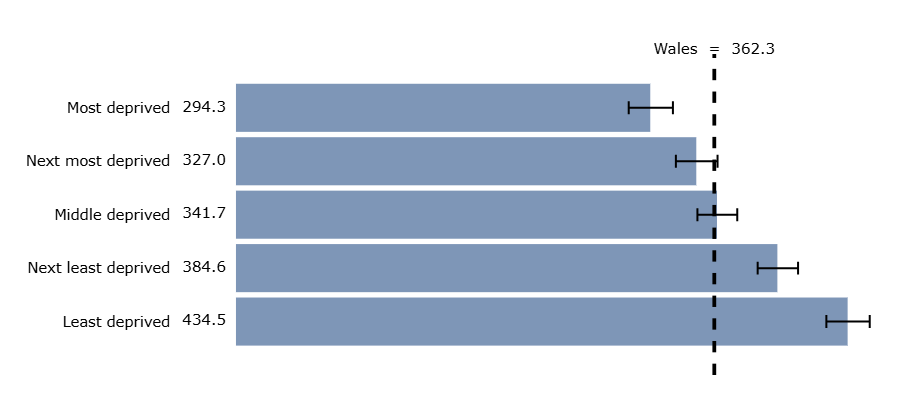
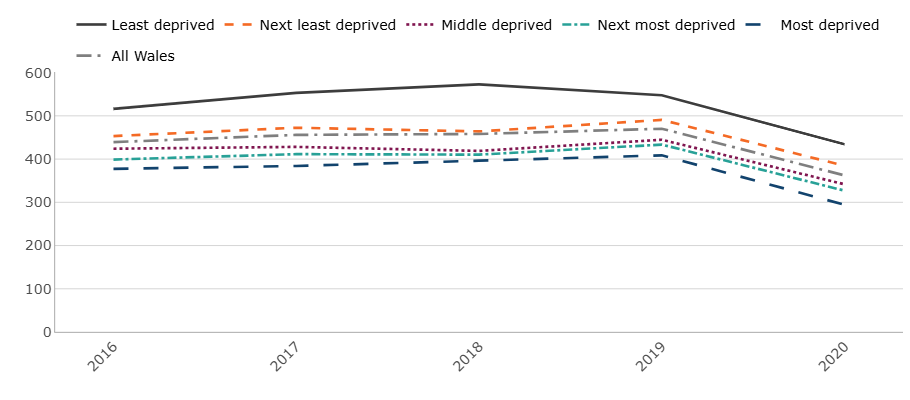
Unlike many types of cancer, NMSC incidence is higher in the least deprived than in the most deprived areas of Wales. This pattern was observed each year from 2016 to 2020. After adjusting for differences in age, NMSC incidence increased in all deprivation fifths from 2016 to 2019 with the largest increase occurring in the next most deprived areas (9% increase). All areas of deprivation saw a decrease in diagnosed cases of NMSC in 2020, similarly to ‘All cancers excluding NMSC’ (see the cancer incidence in Wales report for more information).
In 2020, the incidence rate was 48% higher in the least deprived areas than in the most deprived areas. Although NMSC incidence is highest in the least deprived areas, the most deprived areas saw the biggest reduction in the age-standardised incidence rate (28% decrease) in 2020. The gap in NMSC incidence rates between areas of deprivation is similar for men and women.
NMSC incidence, European age-standardised rate per 100,000, persons, all ages, Wales by deprivation fifths, 2020
Produced by Public Health Wales, using incidence and pathology data (WCISU), MYE (ONS) and WIMD (WG)
NMSC incidence, European age-standardised rate per 100,000, persons, all ages, Wales by deprivation fifths, 2016-2020
Produced by Public Health Wales, using incidence and pathology data (WCISU), MYE (ONS) and WIMD (WG)
Geography
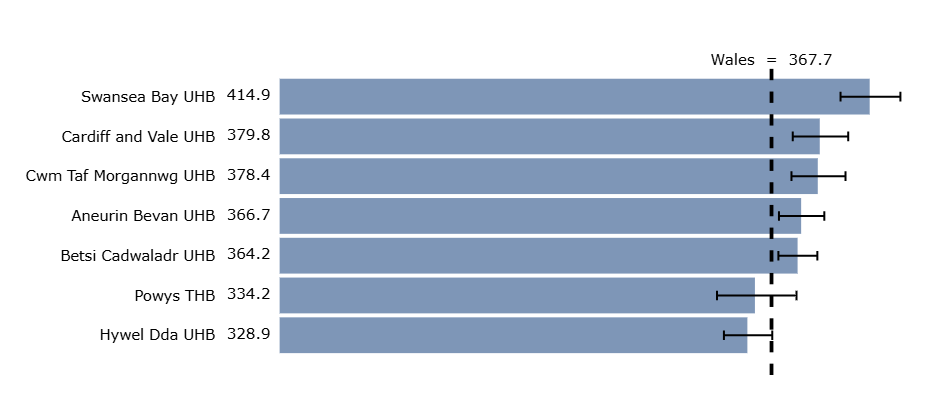
There is considerable geographic variation in NMSC incidence between regions of Wales. After adjusting for differences in age, the NMSC incidence rate in the Swansea Bay Health Board area was 1.3 times higher than in the Hywel Dda Health Board area and was over 1.2 times higher than the Powys Health Board populations. Without adjusting for age, areas with older populations, such as Betsi Cadwaladr and Powys Health Boards, had higher rates of NMSC incidence, as well as some of the more southern areas.
The variation between geographical areas illustrates that age plays a major role in NMSC incidence in Wales.
NMSC incidence, European age-standardised rate per 100,000, persons, all ages, Wales by health board, 2020
Produced by Public Health Wales, using incidence and pathology data (WCISU) and MYE (ONS)
Age
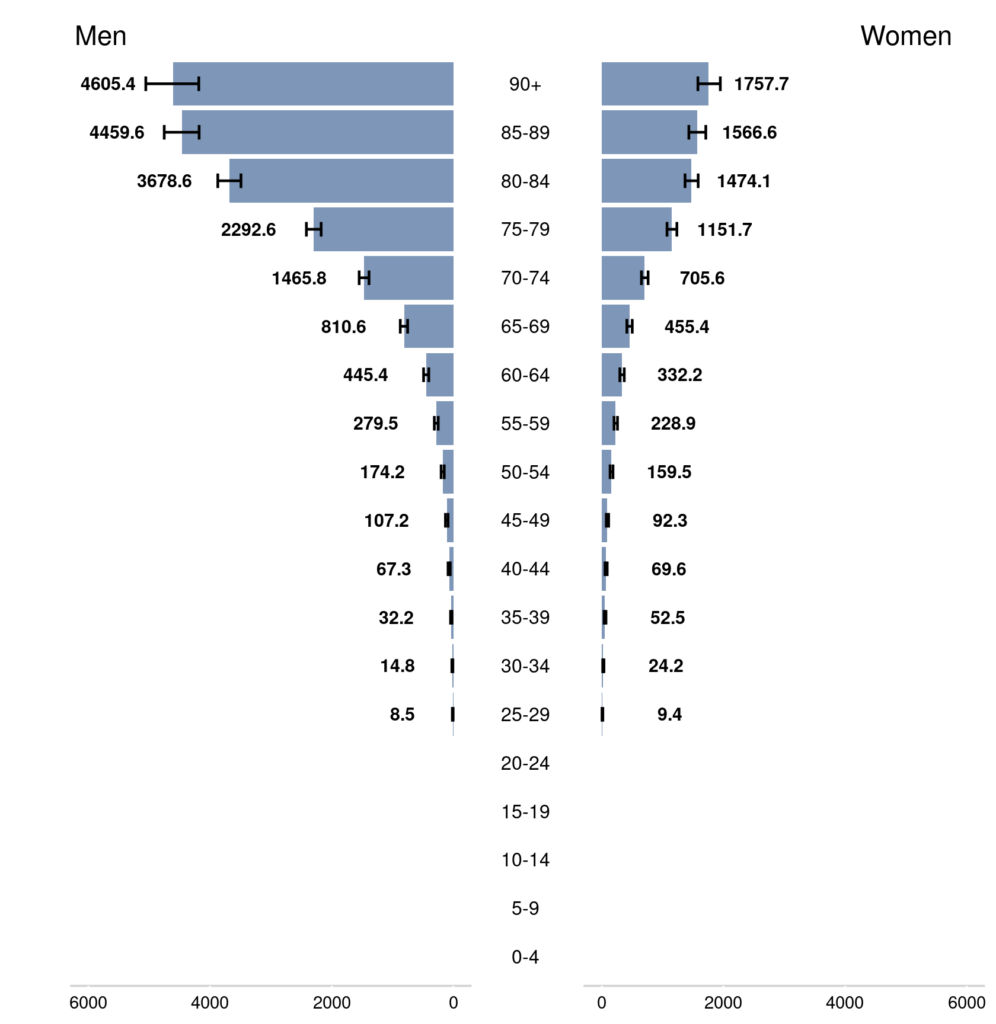
Age is a major risk factor for developing NMSC, with over 80% of first occurrences developing in people over the age of 65 in Wales in 2020. The age-specific incidence rate was over six times higher in 80-84 year-olds compared to 60-64 year-olds.
Age is directly related to UV exposure as older people have more cumulative exposure to the sun compared to younger people, resulting in the increased incidence we see in older age groups. DNA damage and mutations within skin cells accumulate over time so cancer is more likely to develop in older age.
NMSC incidence, age-specific rate per 100,000, men and women, all ages, Wales by five-year age band and sex, 2020
Produced by Public Health Wales, using incidence and pathology data (WCISU) and MYE (ONS)
Cancer location on the body
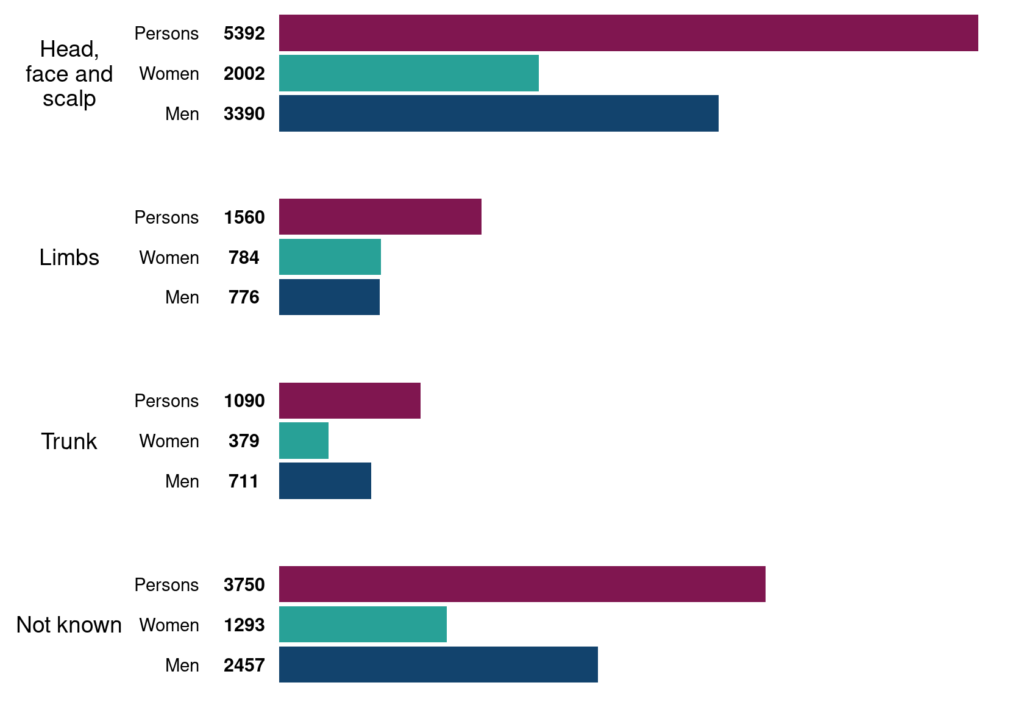
Nearly half of first occurrences of new NMSC cases developed on the head, face, scalp and neck in Wales in 2020. These tend to be sun-exposed areas of the body, showing the importance of protective behaviour in the sun such as seeking shade, clothing and hat-wearing, and sun-lotion use.
NMSC incidence, count, persons, all ages, Wales by tumour location and sex, 2020
Produced by Public Health Wales, using incidence and pathology data (WCISU)
UK context
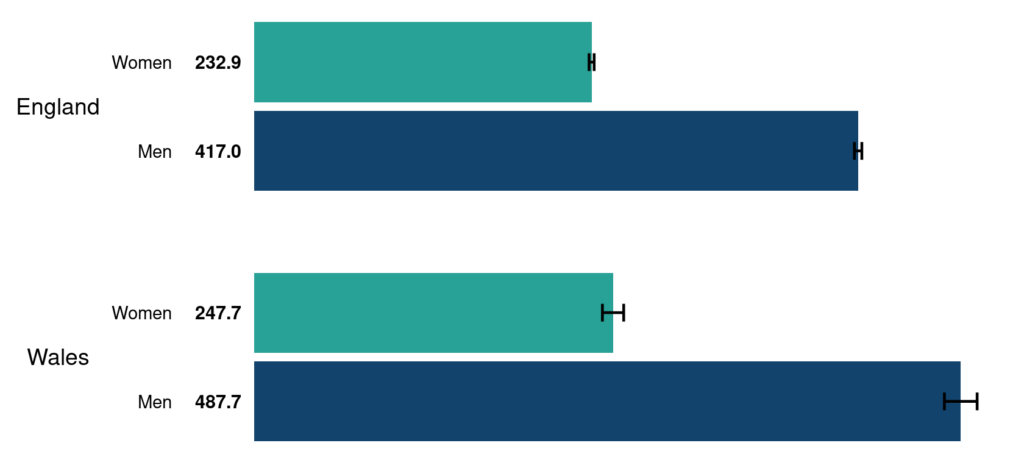
In 2020, after adjusting for differences in age, both men and women had significantly higher incidence of NMSC in Wales compared to England. The incidence rate was 6% higher in women and 17% higher in men in Wales. For more information on NMSC incidence in England, please see the ‘Get Data Out Programme.’
NMSC incidence, European age-standardised rate per 100,000, men and women, all ages, by UK jurisdiction and sex, 2020
Produced by Public Health Wales, using incidence and pathology data (WCISU) and MYE (ONS)
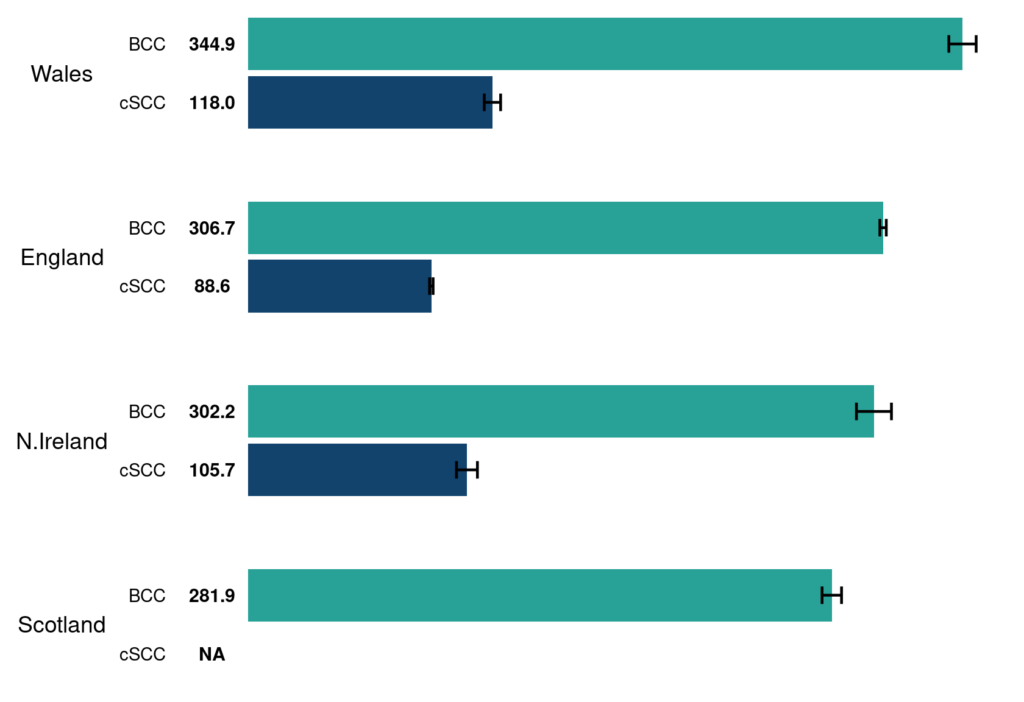
After adjusting for differences in age, Wales had the highest incidence rate of BCC and cSCC in 2018 compared to the other UK countries and jurisdictions. For more information on NMSC incidence in other UK countries and jurisdictions, please see Kwiatkowski et al. (2021).
NMSC incidence, European age-standardised rate per 100,000, persons, all ages, by UK jurisdiction, 2018
Produced by Public Health Wales, using incidence and pathology data (WCISU) and MYE (ONS)
Data tables
Access the data related to this report
Technical information
Pre-release list
Dr Tracey Cooper, NHS Wales Cancer Board Chair and Chief Executive of Public Health Wales
Professor Tom Crosby, National Cancer Clinical Director for Wales
Anthony Davies, Senior Policy Manager, Value Based Healthcare Policy Team, Welsh Government
Related reports
-
Macmillan-WCISU partnership including cancer incidence, prevalence and comorbidities
Contact for queries or feedback Introduction Macmillan Cancer Support and the Welsh Cancer Intelligence and Surveillance Unit of Public Health Wales entered into a partnership in April 2017. The aim is to deliver […]
Published on: 27th March 2019
-
Pathology samples indicating new cases of cancer in Wales
Next update: 18th June 2026 Contact for queries or feedback Introduction This experimental analysis examines the monthly count of individual patients with a pathology sample indicating a primary malignant tumour […]
Published on: 26th March 2026
-
Cancer survival in Wales
Next update: 2027 Contact for queries or feedback Introduction This publication reports on survival of all cancers for registration years between 2002 and 2022. Where possible, one-year, five-year and ten-year […]
Published on: 26th March 2026
-
Cancer mortality in Wales
Next update: 15 July 2026 Contact for queries or feedback Introduction This publication reports on deaths registered between 2002 and 2024 with outputs presented by single and three-year rolling periods […]
Published on: 18th June 2025
-
Public Health Outcomes Framework Reporting Tool
Next update: 17th June 2026 Contact for queries or feedback Introduction Main points In this iteration, the following indicators have been updated: The key messages for these indicators are as […]
Published on: 18th March 2026
-
Cancer incidence in Wales
Next update: To be announced (2026) Contact for queries or feedback Introduction This publication reports on cancers registered between 2002 and 2022 with outputs presented by single and three-year rolling periods […]
Published on: 23rd October 2025
Related data
-
Cancer incidence and prevalence for Cluster Networks in Wales data
Last reviewed: 12th July 2018
-
Non-melanoma skin cancer incidence in Wales data
Last reviewed: 30th May 2024
-
Public Health Outcomes Framework Reporting Tool Data
Last reviewed: 18th March 2026
-
Pathology samples indicating new cases of cancer in Wales data
Last reviewed: 26th March 2026
-
Cancer mortality in Wales data
Last reviewed: 18th June 2025