Non-melanoma skin cancer incidence technical guide
This guidance is associated with:
Introduction
The Welsh Cancer Intelligence and Surveillance Unit’s (WCISU) core function is to discharge one of the statutory duties of Public Health Wales: “To undertake the systematic collection, analysis and dissemination of information about the health of the people of Wales, in particular cancer incidence, mortality, and survival…”
Critical to this duty is the continuous compilation of the national cancer registry of Wales and the production of legal annual official statistics on cancer incidence and survival, in addition to reporting on cancer mortality in the resident population of Wales.
The national cancer registry of Wales is a live and dynamic database of cancer incidence data from 1972 onwards, with approximately 20,000 patients diagnosed each year in Wales (excluding non-melanoma skin cancer). WCISU has been responsible for publishing cancer incidence, mortality and survival in Wales since 1997. Prior to this cancer incidence figures were published by the Office for National Statistics for both England and Wales. In 2009, WCISU became part of the Health Intelligence Division of the newly created Public Health Wales (PHW), and more recently, the Health Intelligence Division became part of the new Knowledge and Research Directorate within PHW (1st April 2019).
This publication is produced by using a snapshot of the dynamic cancer registration database, which is populated and quality assured with data supplied by multiple data providers from NHS Wales Health Boards and Trusts, NHS Wales Informatics Service, Public Health England, and elsewhere within Public Health Wales, such as its Screening Division.
Our statistics are produced to high professional standards set out in the Code of Practice for Official Statistics. They undergo regular quality assurance reviews to ensure that they meet customer needs. They are produced free from any political interference.
This document provides an overview of the data collection process, data quality and the methodology applied. It also provides definitions, notes for interpretation, and details of where to find further information on cancer statistics in Wales.
Methodology
Overview of non-melanoma skin cancer
Skin cancer can be separated into two main types: melanoma and non-melanoma skin cancer (NMSC). Official statistics for melanoma skin cancer can be found in the latest WCISU incidence publication held within the cancer incidence in Wales report.
Several subtypes of skin cancer are categorised as NMSC including keratinocyte cancers (KC) and other rare forms of skin cancer. KC can be further separated into basal cell carcinoma (BCC) and cutaneous squamous cell carcinoma (cSCC). KC form the majority of NMSC cases; BCC ~80% and cSCC ~20%. Rare skin cancers make up <1% of cases in Wales and include types such as Merkel cell carcinoma and cutaneous sarcoma.
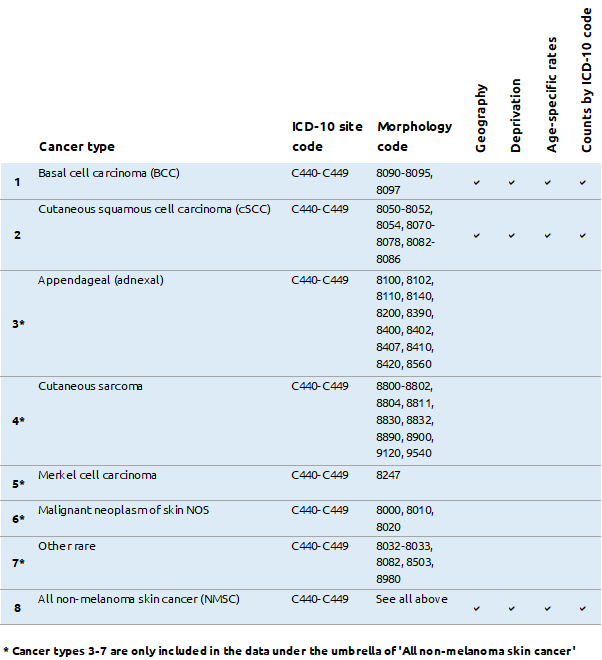
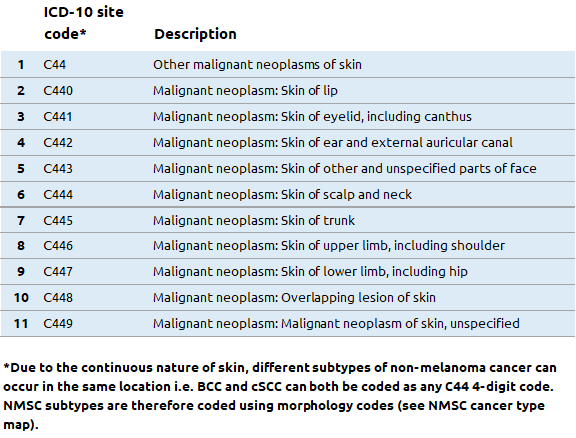
NMSC tumours can be identified by any C44 code under the International Classification of Diseases 10th revision (ICD-10) with the 4th digit denoting the location of the tumour on the body. Morphology codes from the International Classification of Diseases for Oncology, Third Edition (ICD-O-3) are subsequently used to determine the NMSC subtype (BCC, cSCC or rare). Please see the cancer type map and morphology reference table in Appendix A for more information on how NMSC is determined.
Incidence of NMSC is calculated differently to other cancer types due to high numbers of new KC tumours and to account for multiplicity of tumours per patient. There are two recognised methods for counting KC: the ‘first ever method’ and the ‘first per person per annum method (PPPA)’. This publication uses the ‘first PPPA method’ for counting KC instead of the ‘first ever method’ as it gives a more accurate estimate of yearly KC incidence in Wales. The ‘first PPPA method’ also better reflects the burden on healthcare resources to treat KC tumours and gives a fuller picture of the burden of cancer in Wales. The ‘first ever method’ of counting KC has been traditionally used by most UK registries. However, counting KC using the ‘first ever method’ results in an underestimation of the true tumour count by an estimated 50%.
In addition to counting KC, this publication also counts rare non-melanoma skin cancers. However, due to small numbers, rare NMSCs are included in the total incidence of NMSC only (All non-melanoma skin cancer). All tumours for rare skin cancers are fully registered, therefore incidence of rare non-melanoma skin cancer counts all registered tumours and not just first PPPA. The total incidence of NMSC includes the first occurrence in each year of keratinocyte cancers (BCC/cSCC) and all registered tumours of rare skin cancers. It is possible for a person to have a first occurrence of both BCC and cSCC within the same year; in this instance, both occurrences would be counted.
Data are submitted to the WCISU from a range of health care providers and other services (for example, pathology laboratories, multi-disciplinary team meetings, inpatient activity data, radiology, radiotherapy data, death certificates, and other cancer registries in the UK). As the data come from different sources, the quality and accuracy of the data submitted may vary. Registration of the first occurrence of any NMSC tumour was mandated from 2016 in Wales so data completeness of NMSC tumours prior to 2016 is poor. Since registration was only mandated in 2016, it is possible that the first ever tumour was not recorded. In this instance the first registered tumour per patient will be recorded as the first ever tumour.
The WCISU collate and validate the data for each patient, defined as the cancer registration minimum dataset. The cancer registration minimum dataset has been used to identify the first ever or first registered tumour per patient. Pathology report data has been used to identify subsequent NMSC tumours. Data is available for Wales from 2016 to the most recent registration year 2020.
The snapshot of the cancer registration database for this publication was taken in February 2024 for patients diagnosed from the year 2016 to the most current registration year, 2020.
This publication presents non-melanoma skin cancer incidence by single and three-year rolling periods for men, women and persons from 2016 to 2020 for:
- Wales
- Health boards
- Local authorities
- Area deprivation fifths
Counts, crude rates and European age-standardised rates (EASR) are presented for each of the above breakdowns for `All non-melanoma skin cancer (All NMSC)`, along with two NMSC subtypes classed under malignant neoplasms: basal cell carcinoma (BCC) and cutaneous squamous cell carcinoma (cSCC).
Unlike other cancer types, NMSC can develop at any site on the body. NMSC incidence by tumour location (site group) is presented from 2016-2020 for Wales for men and women by single year and five-year age band.
Counts are presented for the above for `All non-melanoma skin cancer`, and BCC and cSCC subtypes.
A list of non-melanoma skin cancer types used in this publication along with ICD-10 codes and breakdowns can be found in Appendix A. A further list of NMSC subtypes, with accompanying morphology codes can also be found in Appendix A.
Reported characteristics
Geographical area
Analysis presented by geographical area, namely local authority, health board and at an all-Wales level, is based on an individual’s area of residence at time of diagnosis.
There are seven health boards within Wales. As of 1st April 2019, these are: Aneurin Bevan University Health Board, Betsi Cadwaladr University Health Board, Cwm Taf Morgannwg University Health Board, Cardiff and Vale University Health Board, Hywel Dda University Health Board, Powys Teaching Health Board and Swansea Bay University Health Board.
Prior to 1st April 2019, the seven health boards were: Abertawe Bro Morgannwg University Health Board, Aneurin Bevan University Health Board, Betsi Cadwaladr University Health Board, Cwm Taf University Health Board, Cardiff and Vale University Health Board, Hywel Dda University Health Board and Powys Teaching Health Board.
On 1st April 2019 the responsibility for healthcare services in Bridgend County Borough Council area transferred to Cwm Taf University Health Board (now renamed Cwm Taf Morgannwg University Health Board) from Abertawe Bro Morgannwg University Health Board (now renamed Swansea Bay University Health Board), with the health board boundary moving accordingly.
As such, the names of the health boards changed to reflect the new geographical boundaries.
All analysis in this publication are reported using the current health board boundaries, including years prior to 1st April 2019.
There are 22 local authority areas in Wales. They were established in 1996 and are nested within the health board areas.
Area deprivation
Analysis by deprivation is presented by deprivation fifths. The Welsh Index of Multiple Deprivation (WIMD) is the official measure of relative deprivation at small area level in Wales. WIMD is made up of eight separate domains of deprivation: income, employment, health, education, housing, access to services, environment and community safety.
WIMD is used to give an overall deprivation rank for each of the 1,909 Lower Super Output Areas (LSOA) in Wales and to give ranks for the separate deprivation domains for each of the LSOAs.
Deprivation ranks are calculated for each LSOA in Wales. One area has a higher deprivation rank than another if the proportion of people living there that are classed as deprived is higher. The most deprived area is ranked as one and the least deprived area is ranked as 1,909. WIMD is an ecological measure whereas an individuals experience within an area (LSOA in this instance) may vary. Not everyone living in a deprived area is deprived and not all deprived people live in deprived areas. An area itself is not deprived, it is the circumstances and lifestyle of people who are living there that affects its deprivation ranks.
Each of the eight domains are based on a range of different indicators. The domain indices are weighted and combined into an overall index of multiple deprivation.
The ‘overall score’ (all domains) is used for all the WCISU’s Official Statistics publication. The deprivation fifths (1 = least deprived; 5 = most deprived) are based on the population, with an equal number of residents in each fifth, rather than equal number of LSOAs in each fifth. This publication uses 2014 mid-year population estimates to assign an equal number of residents in each fifth, with LSOA deprivation ranks from WIMD 2019.
Further details on WIMD can be found in Welsh index of multiple deprivation 2019.
Reported measures
Count
In this publication, this refers to the number of cancers diagnosed over a particular period of time. Incident cases of cancer are counted for each separate primary tumour; one person may be diagnosed with more than one primary tumour and would then appear twice in the incidence statistics; secondary tumours and recurrences of a previous cancer are not counted as new incident cases.
Crude rates
A crude rate is the number of events occurring in a population over a specific time period, often expressed as the number of events per 100,000 of the population. Both the numerator (number of events) and denominator (mid-year population estimate) are based on the same geographical area and time period.
The crude rate is defined as total registrations per 100,000 population, or:
Crude rates were not calculated where there were fewer than three events.
Age-standardised rates
The incidence of cancer varies greatly with age. Differences in the age structure of populations between geographical areas or over time therefore need to be controlled to give unbiased comparisons of incidence. Age-standardisation allows comparison of rates across different populations while taking account of the different age structures of those populations.
This is achieved by applying the observed age- and sex-specific incidence rates for each population to a standard population. These are then summed to give an overall rate per 100,000 population. The standard population used here is the European Standard Population (ESP). The first version of the ESP was introduced in 1976, with the second version in 2013. This publication, along with all the WCISU publications since June 2014 have used the 2013 ESP. Age-standardised rates using differing standard populations are not comparable.
Although the 2013 ESP has separate categories for 90-94 and 95+, the WCISU combines these into a single category for 90+. This is because population data is not consistently available for the 95+ age group for all years or geographies. The Office for National Statistics (ONS) carried out a study looking at the impact of using an 85+, 90+ or 95+ upper age limit for calculating age-standardised mortality rates and found no significant differences between rates calculated with upper age limits of 90+ and 95+. As there is currently not widespread availability of population estimates for the 95+ group, they recommend the use of an upper age limit of 90+ for the 2013 ESP.
A lower age limit of 0-4 years is used for all European age-standardised rates in this publication. This is in line with the other cancer registries in the UK and Ireland.
Age-standardised rates were not calculated where there were fewer than 10 events.
Thus, the directly standardised incidence rate using the European Standard Population is given by:
where:
- = the observed incidence rate in age group k
- = registrations in age group k
- = population in age group k
- = 0-4, 5-9, … , 85-89, and 90 and over
- = European standard population in age group k
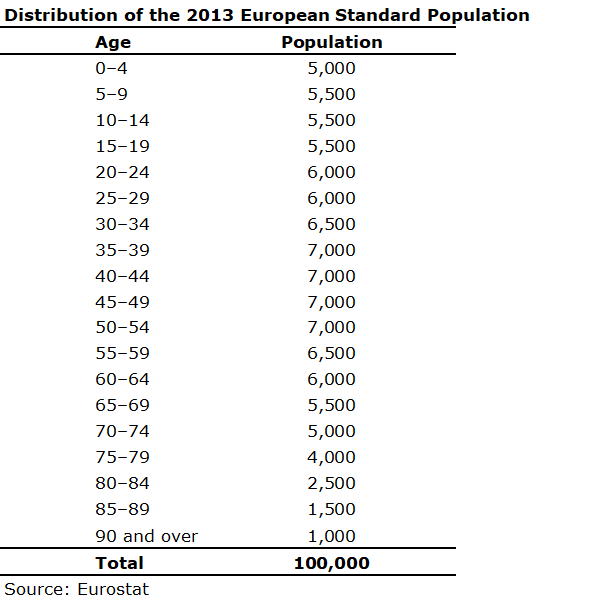
The 2013 European Standard Population distribution can be found in Appendix B.
Confidence intervals
Confidence intervals are produced alongside EASRs for geographical and deprivation analysis, and alongside crude rates for age analysis.
Confidence intervals are indications of the natural variation that would be expected around an estimate and they should be considered when assessing or interpreting an estimate. The size of the confidence interval is dependent on the number of events occurring and the size of the population from which the events came. Generally, estimates based on small numbers of events and small populations are likely to have wider confidence intervals. Conversely, estimates based on large populations are likely to have narrower confidence intervals.
In this publication, we calculate 95 per cent confidence intervals. This represents a range of values that we can be 95 per cent confident contains the ‘true’ underlying estimate.
Confidence intervals calculated alongside EASRs use the modified gamma distribution method by Tiwari et al. (2006). This is a modification of the formula for the upper confidence limit of the original confidence intervals for directly standardised rates based on the gamma distribution, as proposed by Fay and Feuer (1997). Confidence intervals calculated alongside CRs use Byar’s method when the numerator (count) is at least ten and the exact chi-squared method (Armitage and Berry, 2002) when the numerator is less than 10.
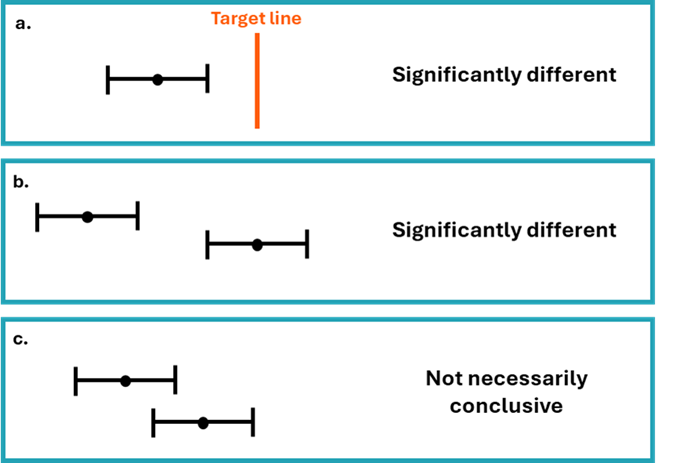
Comparisons are often made between two or more estimates, for example between different areas or time periods. Sometimes in such cases statistical testing is undertaken by comparing the confidence intervals of the estimates to see if they overlap. Non-overlapping confidence intervals are considered as statistically significantly different. Whilst it is safe to assume that non-overlapping confidence intervals indicate a statistically significant difference, it is not always the case that overlapping confidence intervals do not. A more exact approach is to calculate the ratio of the two estimates, or the difference between them, and construct a test or confidence interval based on that statistic. Such methods are not covered in this technical guide, but can be found in a standard textbook.
Geographical analysis in this publication indicate whether the EASRs is significantly different compared to the Wales rate for the area, cancer site and time period. In this instance, significant difference is indicated by whether the confidence intervals for the particular area overlaps or not with the confidence intervals around the Wales estimate for the cancer site and time period.
Populations
ONS mid-year population estimates from the relevant time periods are used as the denominator for rate calculations. Full guidance on the methodology used by ONS to calculate population estimates can be accessed here.
Note: Rebased population estimates by local authority from mid-2012 to mid-2020 are used as the denominator for the geographical analysis to align with census 2021. Details on rebasing of mid-year estimates can be accessed here.
Rebased population estimates by lower super output areas from mid-2011 to mid-2020 were not available at the time of analysis. The deprivation analysis for this time period therefore uses a different denominator for rate calculations, producing a Wales estimate that is different to the geographical analysis.
Relevance
The release of official statistics by the WCISU is authorised in law by:
- The Pre-release Access to Official Statistics (Wales) Order 2009
- Official Statistics (Wales) Order 2013 made under section 65(7) of the Statistics and Registration Service Act 2007
We believe the key users of statistics regarding cancer incidence are:
- The public and community groups
- NHS Wales as a whole, and Health Boards, Trusts, and the NHS Wales Cancer Implementation Group and Wales Cancer Network, as well as other teams in Public Health Wales and other national and local public bodies
- Professional bodies, clinicians of all disciplines, and policy makers
- Cabinet secretary, Ministers and their civil servants
- Other government departments
- Senedd Members and the Members Research Service
- Third sector and charities
- Media
- Students, academics and universities – to provide valuable reference data for academics and researchers to engage in cancer related research, including the WCISU’s direct participation in research collaborations
- The private sector
We encourage users of the statistics to contact us to let us know how they use the data, please see the contact details at the top of this page. Acknowledgement to Public Health Wales NHS Trust is to be stated if reproducing material in this document or accompanying outputs.
Accuracy
Cancer registration
The registration of cancer cases is a dynamic process in the sense that the database is always open and changing. The database is dynamic in a number of ways:
- New cancer cases will be registered: this can include new ‘late’ registrations, where a case is registered after the cancer registry have published what were thought at the time to be virtually complete results for a particular year
- Cancer records can be amended: for example the site code would be modified should later and more accurate information become available
- Cancer records can be deleted, although this is relatively unusual
In common with cancer registries in other countries, cancer registrations in Wales can take up to five years after the end of a given calendar year to reach 100% completeness, due to the continuing accrual of late registrations, amendments and deletions.
Wales implemented a new cancer registration system named CATRIN in 2015. This is the same as the ENCORE system used in Public Health England, which has inbuilt registration validations. This modernisation programme has improved cross border data sharing in particular. The data migration process placed a particular emphasis on reducing duplicate registrations existing in both Wales and England registry databases. A quality assurance and de-duplication exercise was undertaken to rationalise the cancer registrations across the two countries. Therefore, this may reflect in a reduction of incidence.
Cancer registrations comply with a quality assurance framework comprising of a suite of quality checks performed at various time points during the registration year e.g. monthly, quarterly and end of year checks. These check the data consistency of the cancer site, sex and associated histology as well as validity checks on dates, for example, to check invalid combinations for behaviour and site/histology; check that the incidence date is not after the date of death. These checks align to those published in 2018 by the European Network of Cancer Registries (ENCR).
All our outputs include information on coverage, timing and geography.
Once the expected cancer records for any registration year have been validated, a snapshot of the data is taken to ensure that there is a consistent set of data behind the official statistics for a period of 12 months. Subsequent snapshots of data are taken monthly and can be used in further cancer publications, queries and parliamentary questions.
When the WCISU submits registrations for the next reporting year, they can also submit “late registrations” for previous years. If any new “late” registrations for earlier years passed all quality checks, they would be included in the subsequent refreshed dataset. This results in small differences in the underlying number of cancer registrations for previous reports, although these changes are unlikely to have a meaningful impact on cancer incidence.
The snapshot of the cancer registration database for this publication was taken in February 2024. In the unlikely event of incorrect data being published, revisions would be made and users informed in conjunction with the Code of Practice.
Timeliness and punctuality
Historically, the WCISU has routinely published data on new cancer diagnoses (incidence) within 18 months of the end of the calendar year. The lapse in time is due to the source data being completed and becoming available, the time taken to process and merge all cancer registrations for those patients resident in Wales into one record for each tumour using the data sources provided to the WCISU, according to strict international rules and guidelines of coding, classification and staging.
This publication is delayed as both the registration and analysis teams in the WCISU were affected by COVID-19 with resources redeployed to support the PHW response to the pandemic.
All outputs adhere to the Code of Practice by pre-announcing the date of publication through the upcoming calendar on the Welsh Government Statistics and research page. Furthermore, if publication needs to be postponed this will be announced and the reason for the change fully explained, as set out in the Code of Practice.
Accessibility and clarity
The statistics will be published in an accessible, orderly, pre-announced manner on the Welsh Cancer Intelligence and Surveillance Unit’s website at 9:30am on the day of publication. We also publicise the outputs on social media and to our stakeholders via email. All outputs are available and free to download.
The Official Statistics for “Non-Melanoma Skin Cancer Incidence in Wales, 2016 to 2020” are sent to a number of individual people on the pre-release list five working days prior to the announcement in accordance with the Pre-publication Official Statistics Order Access (Wales) 2009. The individuals on the pre-release list can be found on the publication webpage.
We aim to use plain English in our outputs and they adhere to the Public Health Wales’s accessibility policy. Furthermore, all our statistics are published in Welsh and English. Further information regarding the statistics can be obtained by emailing [email protected].
Comparability and coherence
As there are differing methods of counting NMSCs (first ever and first per person per annum), the data in this publication may not be comparable to data from Northern Ireland, England and Scotland on non-melanoma skin cancer incidence.
While the WCISU does not hold cancer incidence data about residents in Northern Ireland, Scotland, and England, data for NMSCs can be located from the following:
- Northern Ireland Cancer Registry
- Scottish Cancer Registry
- Office for National Statistics
- National Cancer Registration and Analysis Service, Public Health England
Details of cancer registries in the United Kingdom and Ireland can be found on the United Kingdom and Ireland Association of Cancer Registries website.
The WCISU are currently compiling their 2021 UKIACR performance indicators. Further information regarding the data completeness and quality of cancer registry data is detailed in the UKIACR performance indicators reports.
Legislation
The WCISU adhere to the ENCR cancer guidelines for registering cancer diagnoses in Welsh residents. Under the Data Protection Act, the lawful processing of patient/service user data for purposes other than that necessary for the direct provision of care requires one of the following conditions to be met:
- Explicit patient/service user consent for processing
- Explicit authorisation by statute
- Approval under Section 251 of the NHS Act 2006
Public Health Wales undertakes a number of activities that cannot be classed as direct care, but where the obtaining explicit consent would be impractical or would compromise the integrity of the relevant activity. Examples include:
- Evaluation of screening programmes
- Cancer registration
- Registration of congenital anomalies
So called ‘Section 251’ approval, therefore, remains the most appropriate means of ensuring that Public Health Wales complies with the Data Protection Act when undertaking such processing. Such approval needs to be obtained for new activities and renewed annually for existing activities.
Section 251 was established to provide a secure legal basis for the disclosure and processing of confidential information in the NHS where it is not possible to use anonymised information or to obtain explicit consent. A mechanism was established to enable the Secretary of State for Health to exercise powers of approval under Section 251, advised by the National Information Governance Board (NIGB) and its Ethics and Confidentiality Committee (ECC). The mechanisms operated by NIGB and its ECC also applied to Wales.
Under General Data Protection Regulation (GDPR), we follow:
- Article 6 (1) e – processing is necessary for the performance of a task carried out in the public interest or in the exercise of official authority vested in the controller
- Article 9 (2) h – processing is necessary for the purposes of preventive or occupational medicine, for the assessment of the working capacity of the employee, medical diagnosis, the provision of health or social care or treatment or the management of health or social care systems and services on the basis of Union or Member State law or pursuant to contract with a health professional and subject to the conditions and safeguards referred to in paragraph 3.
The key policy on cancer in Wales is set out in the Welsh Government’s “The Quality Statement for Cancer.”
The Well-being of Future Generations Act 2015 is about improving the social, economic, environmental and cultural well-being of Wales. The Act puts in place seven well-being goals for Wales. These are for a more equal, prosperous, resilient, healthier and globally responsible Wales, with cohesive communities and a vibrant culture and thriving Welsh language. Under section (10) (1) of the Act, the Welsh Ministers must:
- Publish indicators (“national indicators”) that must be applied for the purpose of measuring progress towards the achievement of the Well-being goals
- Lay a copy of the national indicators before the National Assembly. The 46 national indicators were laid in March 2016
Further information on the Well-being of Future Generations (Wales) Act 2015.
The statistics included in this release could also provide supporting narrative to the national indicators and be used by public services boards in relation to their local well-being assessments and local well-being plans.
The WCISU adheres to the United Kingdom and Ireland Association of Cancer Registries (UKIACR) small numbers guidance for cancer incidence; i.e. where a cancer incidence count of less than five is observed in any cell with the population at risk being less than 1,000 then the value is suppressed. WCISU also adheres to the Office for National Statistics disclosure control guidance for mortality statistics.
Further details
Non-melanoma skin cancer incidence is a new Official Statistics publication produced by WCISU. This publication may be published alongside future cancer incidence Official Statistics publications by WCISU in the future.
Cancer incidence is one of three official statistics publications regularly produced by WCISU alongside cancer survival and cancer mortality.
Appendix A
NMSC cancer type map
ICD-10 code description
Appendix B
2013 European standard population